
Four Treasures Reference Database
Record No. 27114
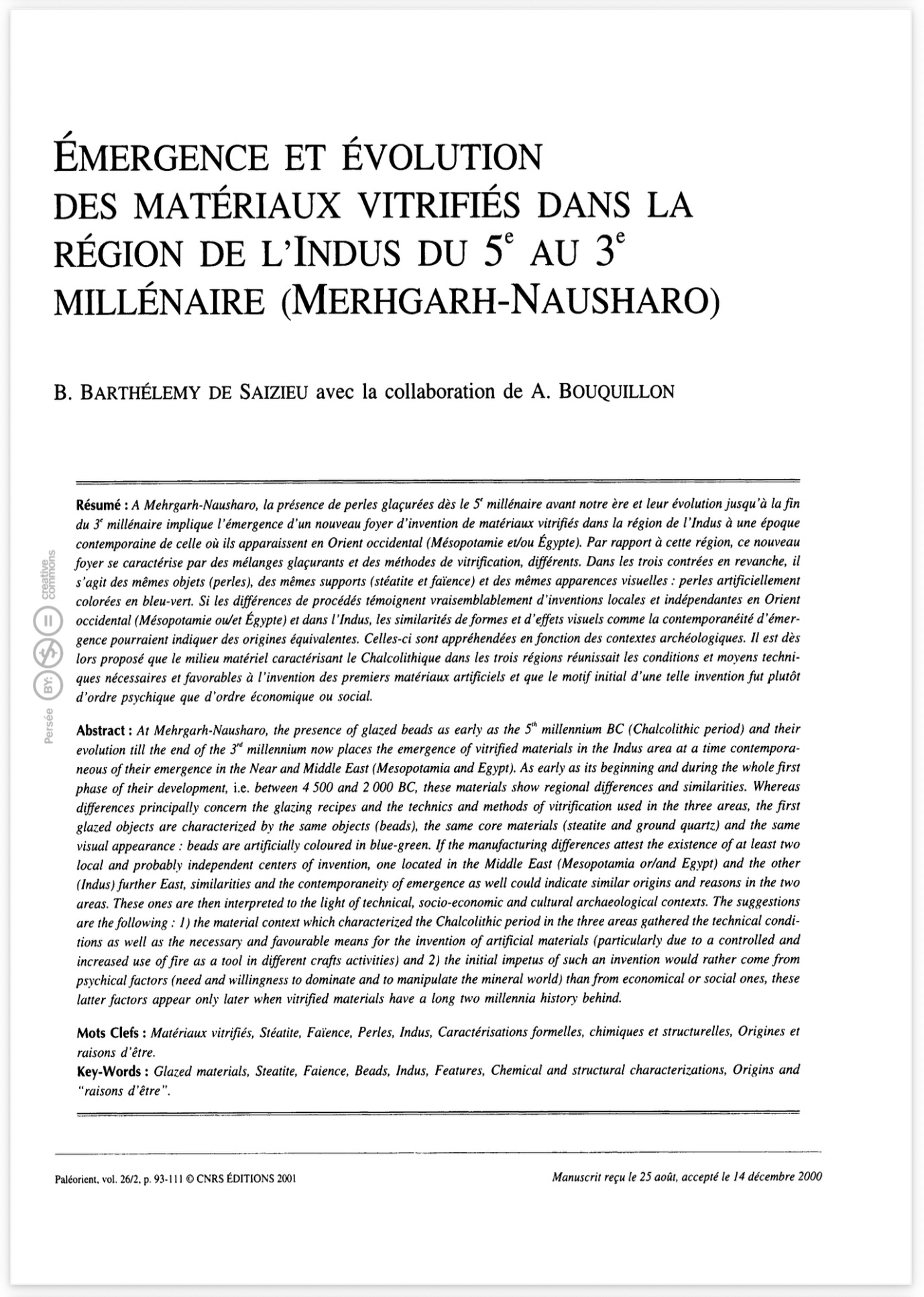
Émergence et Évolution des matériaux vitrifiés dans la région de l’Indus du 5ᵉ au 3ᵉ millénaire (Merhgarh-Nausharo)
Emergence and evolution of vitrified materials in the Indus region from the 5th to the 3rd millennium (Mehrgarh–Nausharo)
Journal Article
Barthélemy De Saizieu, B. and Bouquillon, A. (2001) Émergence et Évolution des matériaux vitrifiés dans la région de l’Indus du 5ᵉ au 3ᵉ millénaire (Merhgarh-Nausharo). [Emergence and evolution of vitrified materials in the Indus region from the 5th to the 3rd millennium (Mehrgarh–Nausharo)] Paléorient, Vol. 26, No. 2, pp. 93–111.
Sinkankas/Born No.: NIS/NIB | Language: in French | RWHL
gems, faience, manufactured ceramics imitating amazonite, lapis lazuli, turquoise, Merhgarh-Nausharo, Egypt, Mesopotamia
At Mehrgarh-Nausharo, the presence of glazed beads as early as the 5ᵗʰ millennium BC (Chalcolithic period) and their evolution until the end of the 3ʳᵈ millennium now places the emergence of vitrified materials in the Indus area at a time contemporaneous with their appearance in the Near and Middle East (Mesopotamia and Egypt); from the outset and throughout the first phase of their development, between 4500 and 2000 BC, these materials show both regional differences and shared features: while glazing recipes and vitrification techniques vary between the regions, the earliest glazed objects are the same in all three—beads made from steatite or ground quartz, colored artificially in blue-green; though manufacturing differences attest to at least two local and likely independent centers of invention—one in the Middle East (Mesopotamia and/or Egypt) and one in the Indus—similarities and simultaneous emergence suggest comparable origins and motivations; these are interpreted in light of the technical, socio-economic, and cultural archaeological contexts, leading to two main propositions: (1) the material conditions of the Chalcolithic in these regions offered both the technical means and favorable environments for inventing artificial materials (especially via the increased and controlled use of fire in various crafts), and (2) the original impetus for this innovation likely arose more from psychological factors (a desire to master and manipulate the mineral world) than economic or social ones, which only gained relevance after vitrified materials had a long-established history.