
Four Treasures Reference Database
Record No. 27115
The mineralogical knowledge of the ancient Bulgarians according to some medieval sources
Book Section
Kostov, R.I. (2003) The mineralogical knowledge of the ancient Bulgarians according to some medieval sources. In: 50 Years University of Mining and Geology “St. Ivan Rilski”, Sofia: Geology and Geophysics, Vol. 46 , pp. 87–92.
Sinkankas/Born No.: NIS/NIB | RWHL*
gems, Arabic Mineralogy, ancient gems, ancient jewelry, Islamic jewelry, Islamic art, Bulgaria, Pamir, Tajikistan, Persian, early lapidaries
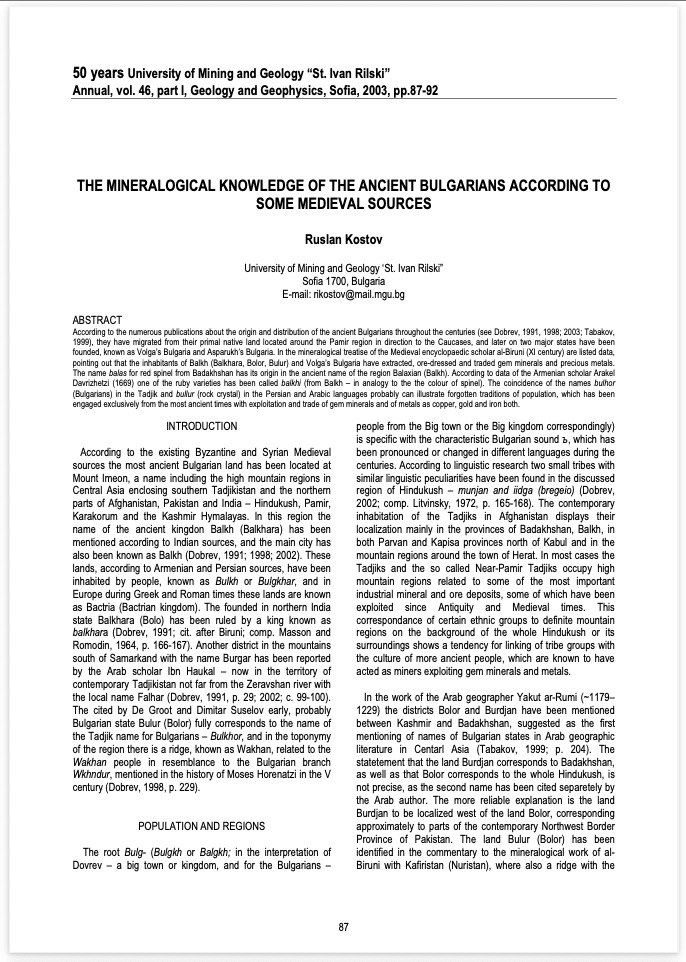
According to the numerous publications about the origin and distribution of the ancient Bulgarians throughout the centuries (see Tabakov, 1999), they have migrated from their primal native land located around the Pamir region in direction to the Caucases, and later on two major states have been founded, known as Volga's Bulgaria and Asparukh's Bulgaria. In the mineralogical treatise of the Medieval encyclopaedic scholar al-Biruni (XI century) are listed data, pointing out that the inhabitants of Balkh (Balkhara, Bolor, Bulur) and Volga's Bulgaria have extracted, ore-dressed and traded gem minerals and precious metals. The name balas for red spinel from Badakhshan has its origin in the ancient name of the region Balaxian (Balkh). According to data of the Armenian scholar Arakel Davrizhetzi (1669) one of the ruby varieties has been called balkhi (from Balkh -in analogy to the the colour of spinel). The coincidence of the names bulhor (Bulgarians) in the Tadjik and bullur (rock crystal) in the Persian and Arabic languages probably can illustrate forgotten traditions of population, which has been engaged exclusively from the most ancient times with exploitation and trade of gem minerals and of metals as copper, gold and iron both.