
Four Treasures Reference Database
Record No. 27118
Texture and structure of opal-CT and opal-C in volcanic rocks
Journal Article
Nagase, T. and Akizuki, M. (1997) Texture and structure of opal-CT and opal-C in volcanic rocks. Canadian Mineralogist, Vol. 35, pp. 947–958.
Sinkankas/Born No.: NIS/NIB | RWHL
gems, opal, Japan
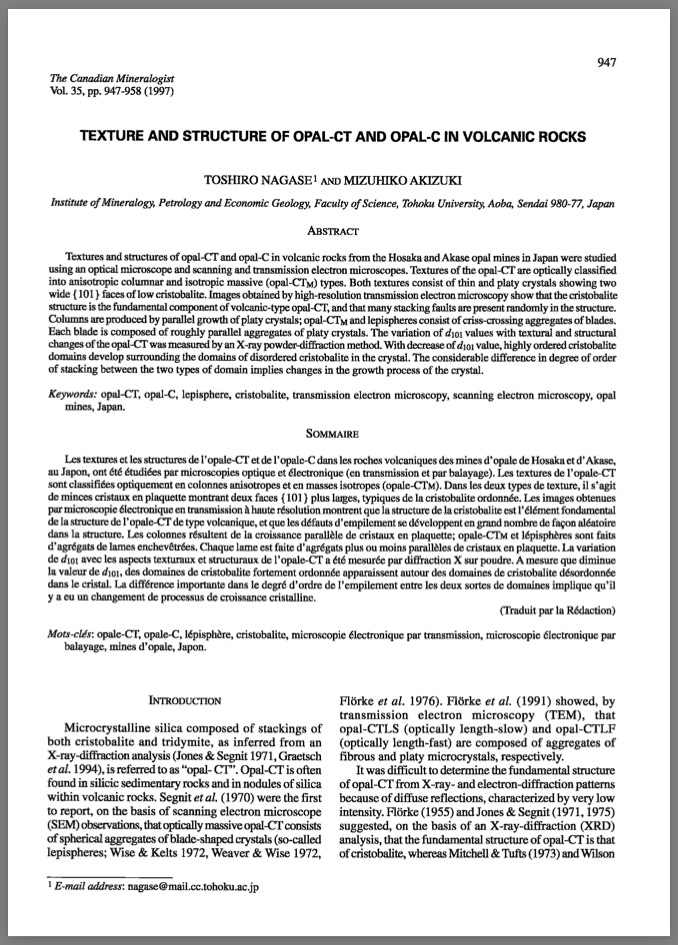
Textures and structures of opal-CT and opal-C in volcanic rocks from the Hoseka and Akase opal mines in Japan were studied using optical microscopy and scanning and transmission electron microscopy. The textures of opal-CT are optically classified into anisotropic columnar and isotropic massive (opal-CTy) types. Both textures consist of thin and platy crystals showing the two wide {101} faces of low cristobalite. High-resolution transmission electron microscopy images reveal that the cristobalite structure is the fundamental component of volcanic-type opal-CT, with numerous randomly present stacking faults in the structure. Columns are formed by parallel growth of platy crystals, while opal-CTy and lepispheres consist of criss-crossing aggregates of blades. Each blade comprises roughly parallel aggregates of platy crystals. The variation in d₁₀₁ values with textural and structural changes of the opal-CT was measured by X-ray powder diffraction. As the d₁₀₁ value decreases, highly ordered cristobalite domains develop around regions of disordered cristobalite within the crystal. The significant difference in stacking order between these two types of domains suggests changes in the crystal’s growth process.