
Four Treasures Reference Database
Record No. 27137
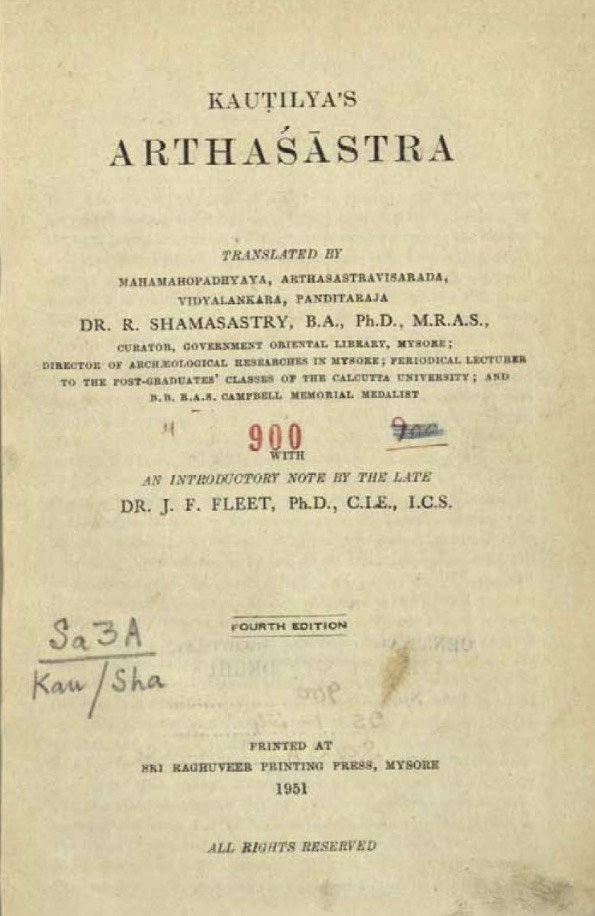
Kauṭilya’s Arthaśāstra
Book
Kauṭilya and Shamasastry, R. (1951) Kauṭilya’s Arthaśāstra. Mysore, Sri Raghuveer, 484 pp.
Sinkankas/Born No.: NIS/NIB | RWHL*
gems, corundum, History.1, Indian gemology, Indian mineralogy, history of gemology, history of mineralogy, Indian lapidary
The Kauṭilya-Arthaśāstra, of which Mr. Shamasastry gives us here his translation, is a work of very exceptional interest and value. In the first place, it ascribes itself in unmistakable terms to the famous Brahman Kauṭilya, also named Vishnugupta, and known from other sources by the patronymic Chanakya, who, tradition tells us, overthrew the last king of the Nanda dynasty, and placed the great Maurya Chandragupta on the throne: this, the two verses with which the work ends recite that it was written by Vishnugupta, who from intolerance of misrule rescued the scriptures, the science of weapons, and the earth which had passed to the Nanda king, and that he wrote it because he had seen many discrepancies on the part of previous commentators: and, in conformity with a common practice of Indian writers, the name Kauṭilya figures constantly throughout the book, especially in places where the author lays down his own view as differing from others which he cites. The work accordingly claims to date from the period 321–296 B.C., and its archaic style is well in agreement with the claim. Secondly, as regards its importance. Kauṭilya is renowned, not only as a great name, but also for being the greatest Indian exponent of the art of government, the duties of kings, ministers, and officials, and of the conduct of diplomacy. That a work dealing with these matters in detail is recited to us by various not less early writers who have given quotations from it. But the work itself remained hidden from modern eyes until it was found in the text of which the translation is laid before us here. The topic of this text is precisely that which has been indicated above, in all its branches, internal and foreign, civil, military, commercial, fiscal, judicial, and so on, including even tables of weights, measures of length, and divisions of time. And it seems to be agreed by competent judges that, though the existing text is, perhaps, not absolutely word for word that which was written by Kauṭilya, still we have essentially, a work that he did compose in the period stated above. The value of it is unmistakable: it not only endorses and extends much of what we learn in some of its lines from the Greek writer Megasthenes, who, as is well known, spent a long time in India as the representative of the Syrian king, Seleucus I, at the Court of Chandragupta, but also fills out what we gather from the epics, from other early writings, and from the inscriptions, and explains many matters and allusions in these last mentioned sources of information which are otherwise obscure: in short, it throws quite a flood of light on many problems in the branch of Indian studies to which it belongs.