
Four Treasures Reference Database
Record No. 27171
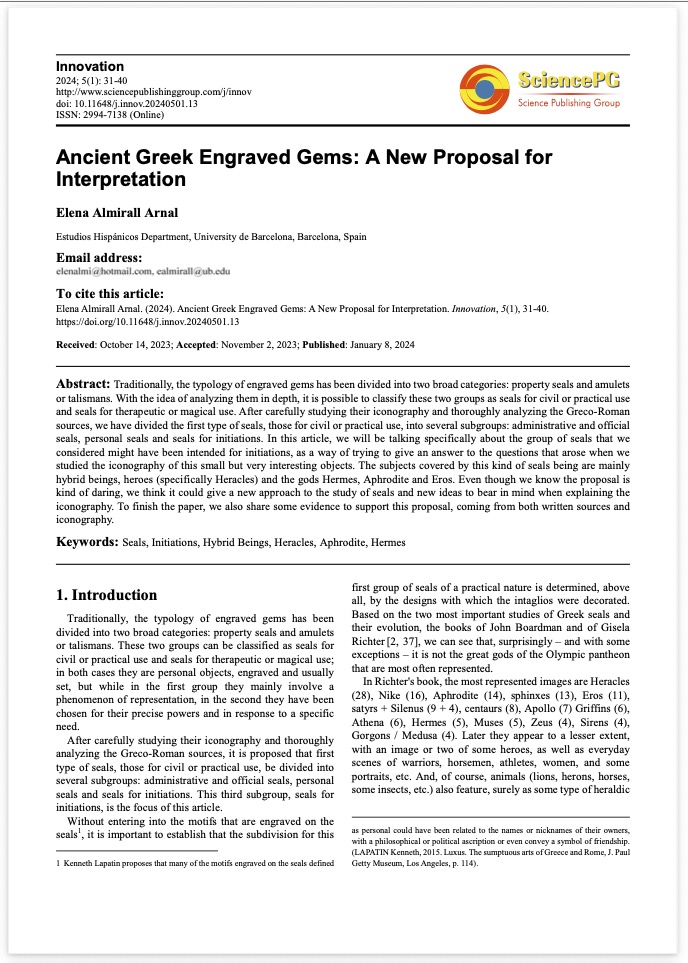
Ancient Greek engraved gems: A new proposal for interpretation
Journal Article
Elena Almirall, A. (2024) Ancient Greek engraved gems: A new proposal for interpretation. Innovation, Vol. 5, No. 1, pp. 31–40.
ISBN/ISSN: 29947138 | DOI: http://doi.org/10.11648/j.innov.20240501.13 | Sinkankas/Born No.: NIS/NIB | RWHL
gems, glyptic, engraved gems, agate, cameo, intaglio, Greece, Rome,
Traditionally, the typology of engraved gems has been divided into two broad categories: property seals and amulets or talismans. With the idea of analyzing them in depth, it is possible to classify these two groups as seals for civil or practical use and seals for therapeutic or magical use. After carefully studying their iconography and thoroughly analyzing the Greco-Roman sources, we have divided the first type of seals, those for civil or practical use, into several subgroups: administrative and official seals, personal seals and seals for initiations. In this article, we will be talking specifically about the group of seals that we considered might have been intended for initiations, as a way of trying to give an answer to the questions that arose when we studied the iconography of this small but very interesting objects. The subjects covered by this kind of seals being are mainly hybrid beings, heroes (specifically Heracles) and the gods Hermes, Aphrodite and Eros. Even though we know the proposal is kind of daring, we think it could give a new approach to the study of seals and new ideas to bear in mind when explaining the iconography. To finish the paper, we also share some evidence to support this proposal, coming from both written sources and iconography.