
Four Treasures Reference Database
Record No. 27176
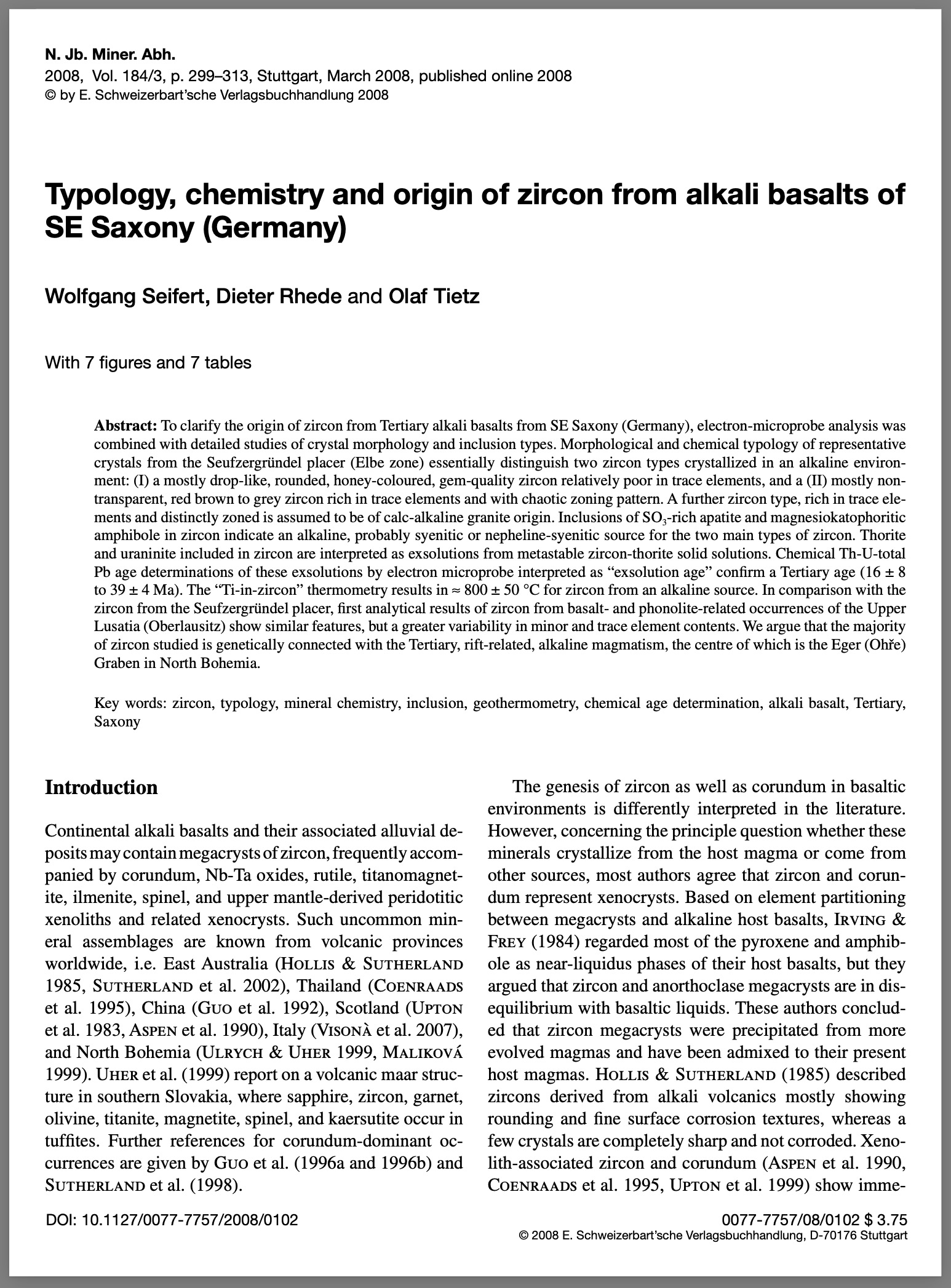
Typology, chemistry, and origin of zircon in alkali basalts of SE Saxony (Germany)
Journal Article
Seifert, A.V., Rhede, D. and Tietz, O. (2008) Typology, chemistry, and origin of zircon in alkali basalts of SE Saxony (Germany). Neues Jahrbuch für Mineralogie Abhandlungen, Vol. 184, No. 3, March, pp. 299–313.
gems, zircon, Saxony, Germany, locality, species
Zircons from Tertiary alkali basalts in SE Saxony, Germany, were studied using electron microprobe, morphology, and inclusion analysis to determine their origin, revealing two primary alkaline-related types from the Seufzergründel placer: (I) gem-quality, honey-coloured, drop-like zircons with low trace element content, and (II) red-brown to grey, non-transparent zircons with chaotic zoning and high trace element content. A third zircon type, rich in trace elements and with clear zoning, likely derives from calc-alkaline granite. Inclusions of SO₃-rich apatite and magnesiokatophoritic amphibole support a syenitic or nepheline-syenitic source for the alkaline types. Thorite and uraninite inclusions are interpreted as exsolutions from metastable zircon–thorite solid solutions, with Th–U–Pb chemical ages yielding an “exsolution age” of 16 ± 8 to 39 ± 4 Ma. Ti-in-zircon thermometry indicates formation temperatures around 800 ± 50 °C. Zircons from related Upper Lusatian basaltic and phonolitic rocks display similar characteristics but more compositional variability. The majority of these zircons are attributed to Tertiary rift-related alkaline magmatism centered in the Eger (Ohře) Graben of North Bohemia.