
Four Treasures Reference Database
Record No. 27184
Moldavites: A review
Journal Article
Trnka, M. and Houzar, S. (2002) Moldavites: A review. Bulletin of the Czech Geological Survey, Vol. 77, No. 4, pp. 283–302.
Sinkankas/Born No.: NIS/NIB | RWHL
gems, natural glass, tektite, moldavite, Bohemia, Moravia, German, Austria, Czech Republic, locality, species
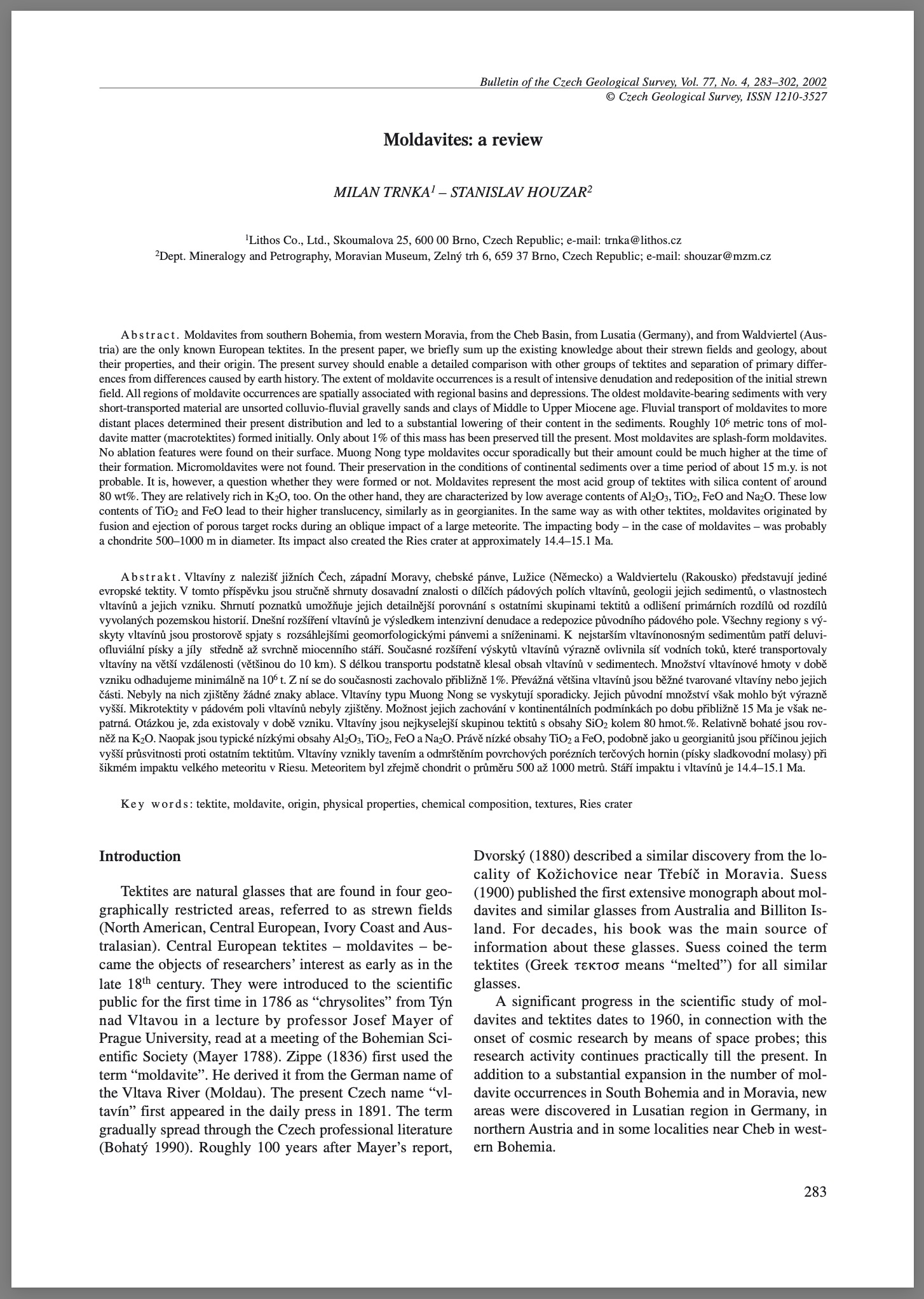
Moldavites from southern Bohemia, western Moravia, the Cheb Basin, Lusatia (Germany), and Waldviertel (Austria) are the only known European tektites. This paper briefly summarizes existing knowledge about their strewn fields, geology, properties, and origin. The aim is to enable detailed comparison with other tektite groups and distinguish primary differences from those caused by Earth’s geologic history. The extent of moldavite occurrences reflects intensive denudation and redeposition of the original strewn field. All regions where moldavites occur are spatially associated with regional basins and depressions. The oldest moldavite-bearing sediments, consisting of unsorted colluvio-fluvial gravelly sands and clays, date to the Middle to Upper Miocene and contain very short-transported material. Fluvial transport to more distant locations accounts for their current distribution and a significant reduction in moldavite content in sediments. Approximately 10⁶ metric tons of moldavite (macrotektite) material were formed initially, but only about 1% has been preserved to the present. Most moldavites are splash-form, with no ablation features on their surface. Muong Nong-type moldavites occur sporadically, though they may have been more abundant originally. Micromoldavites have not been found, and their preservation in continental sediments over ~15 million years is unlikely; it remains uncertain whether they were ever formed. Moldavites are the most acidic tektites, with ~80 wt% silica, relatively high K₂O, and low average Al₂O₃, TiO₂, FeO, and Na₂O. The low TiO₂ and FeO contents contribute to their high translucency, similar to georgianites. Like other tektites, moldavites were formed by fusion and ejection of porous target rocks during the oblique impact of a large meteorite—likely a chondrite 500–1000 m in diameter—which also produced the Ries crater around 14.4–15.1 million years ago.