
Four Treasures Reference Database
Record No. 27186
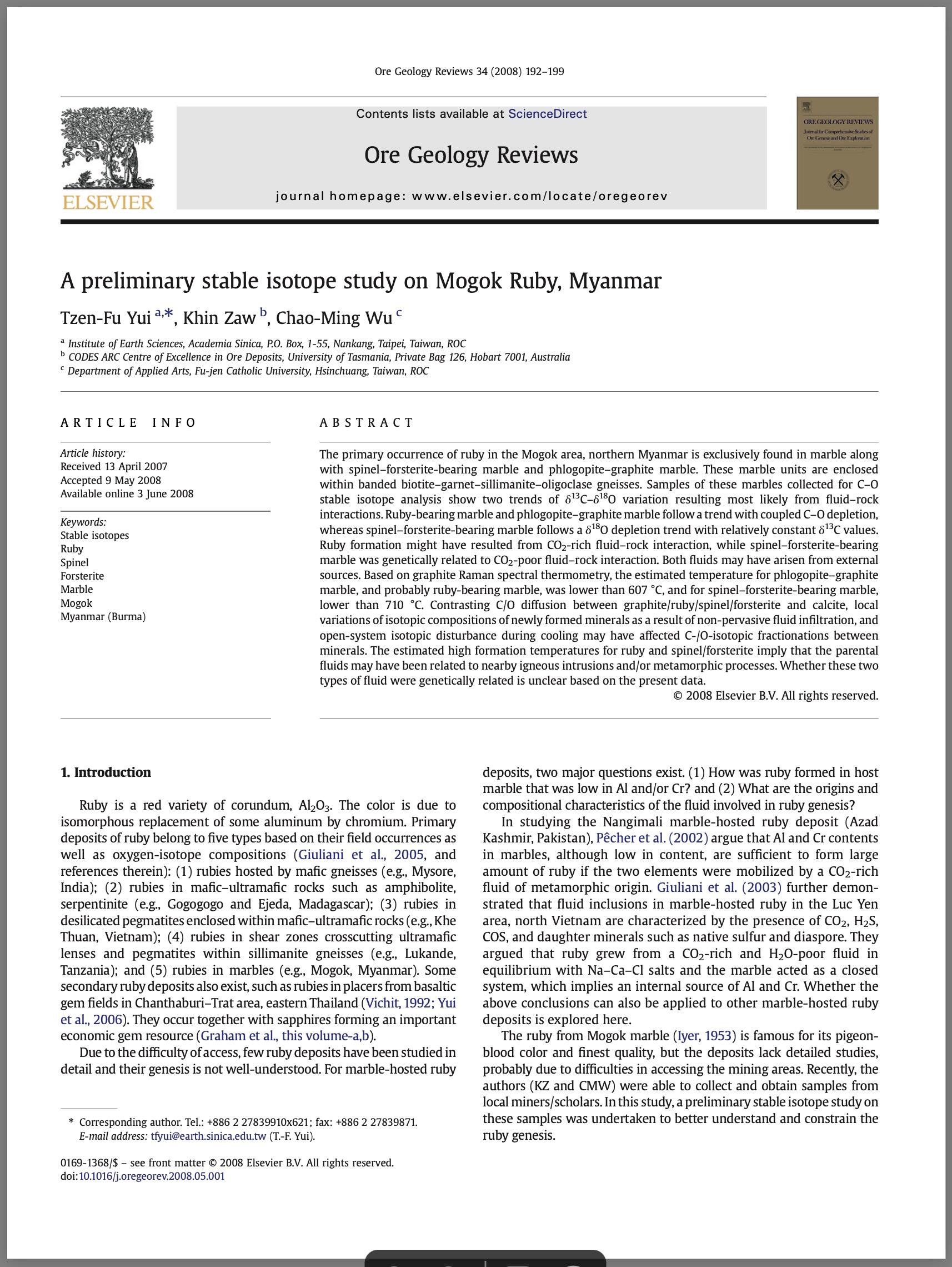
A preliminary stable isotope study on Mogok ruby, Myanmar
Journal Article
Yui, T., Khin Zaw and Wu, C.M. (2006) A preliminary stable isotope study on Mogok ruby, Myanmar. Ore Geology Reviews, Vol. 34, Nos. 1–2, September, pp. 192–199.
gems, corundum, Burma.12, geology.11, Mogok, Mogok Metamorphic Belt,
The primary occurrence of ruby in the Mogok area of northern Myanmar is exclusively found in marble, together with spinel–forsterite-bearing marble and phlogopite–graphite marble. These marble units are enclosed within banded biotite–garnet–sillimanite–oligoclase gneisses. Samples analyzed for C–O stable isotopes display two trends in δ¹³C–δ¹⁸O variation attributable to fluid–rock interaction. Ruby-bearing marble and phlogopite–graphite marble show coupled C–O depletion, whereas spinel–forsterite-bearing marble exhibits δ¹⁸O depletion with nearly constant δ¹³C values. Ruby formation may have resulted from CO₂-rich fluid–rock interaction, while the spinel–forsterite-bearing assemblage appears related to CO₂-poor fluids; both fluid types likely originated externally. Graphite Raman spectral thermometry indicates temperatures below 607 °C for phlogopite–graphite marble (and probably ruby-bearing marble) and below 710 °C for spinel–forsterite-bearing marble. Contrasting C/O diffusion between graphite/ruby/spinel/forsterite and calcite, local isotopic variations produced by non-pervasive fluid infiltration, and open-system isotopic disturbance during cooling may have influenced C/O isotopic fractionations among minerals. The high formation temperatures inferred for ruby and spinel/forsterite suggest parental fluids related to nearby igneous intrusions and/or metamorphic processes. Whether the two fluid types were genetically linked remains unclear from the present data.