
Four Treasures Reference Database
Record No. 27191
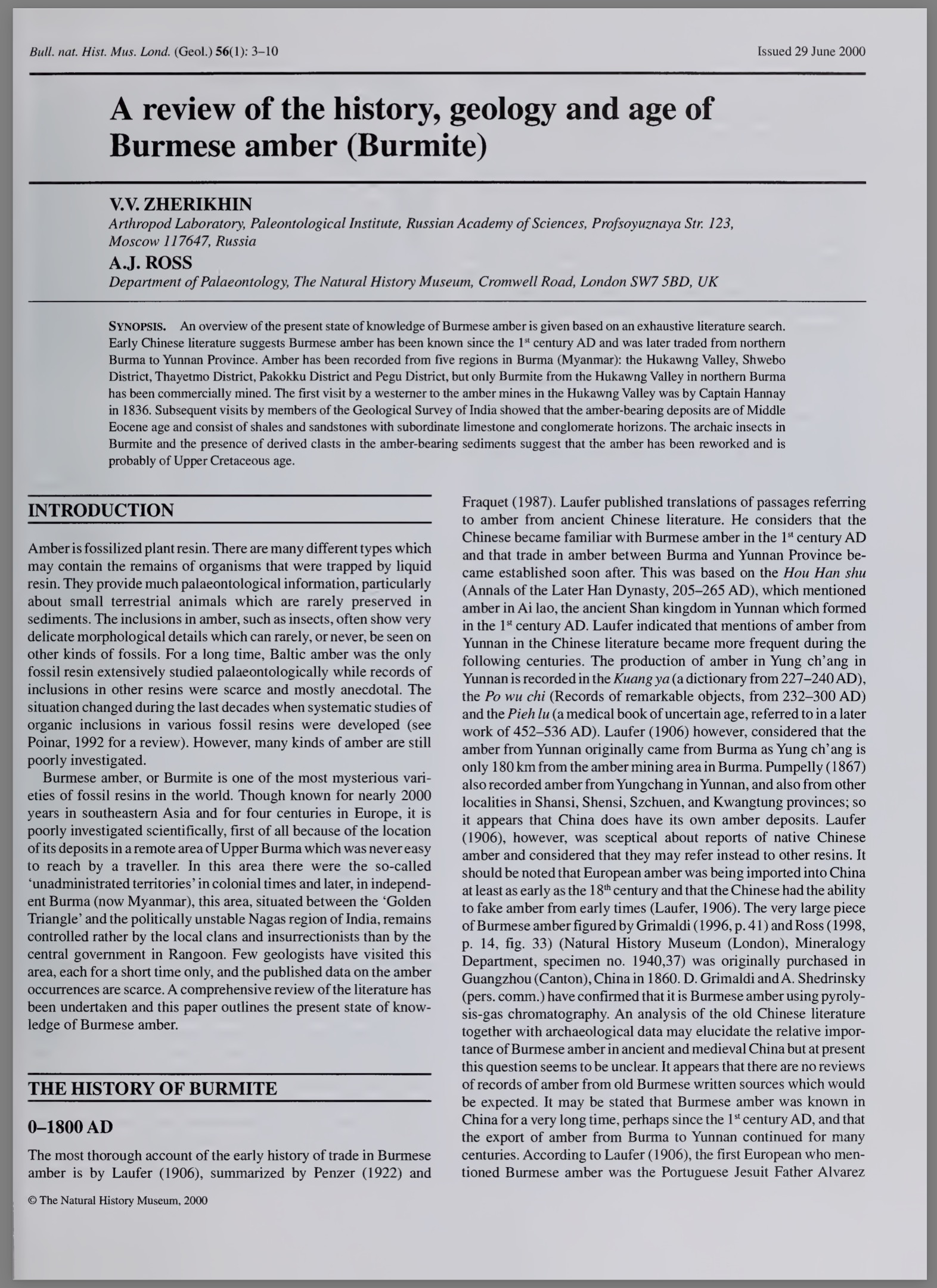
A review of the history, geology and age of Burmese amber (burmite)
Journal Article
Zherikhin, V.V. and Ross, A.J. (2000) A review of the history, geology and age of Burmese amber (burmite). Bulletin of the Natural History Museum, Vol. 56, No. 1, pp. 3–10.
Sinkankas/Born No.: NIS/NIB | RWHL
gems, amber, Burma, Myanmar, Hukawng Valley, burmite
An overview of the current state of knowledge on Burmese amber is presented based on an exhaustive review of the literature. Early Chinese sources indicate that Burmese amber has been known since the 1st century AD and was later traded from northern Burma into China’s Yunnan Province. Amber occurrences have been reported from five regions in Myanmar: the Hukawng Valley, Shwebo District, Thayetmo District, Pakokku District, and Pegu District. However, only Burmite from the Hukawng Valley in northern Myanmar has been commercially exploited. The first visit by a Westerner to the amber mines there was made by Captain Hannay in 1836. Later expeditions by the Geological Survey of India determined that the amber-bearing strata are of Middle Eocene age and consist of shales and sandstones with subordinate limestone and conglomerate layers. The occurrence of archaic insects in Burmite, along with the presence of reworked clasts in the amber-bearing sediments, suggests that the amber itself may be significantly older—likely dating to the Upper Cretaceous.