
Four Treasures Reference Database
Record No. 27205
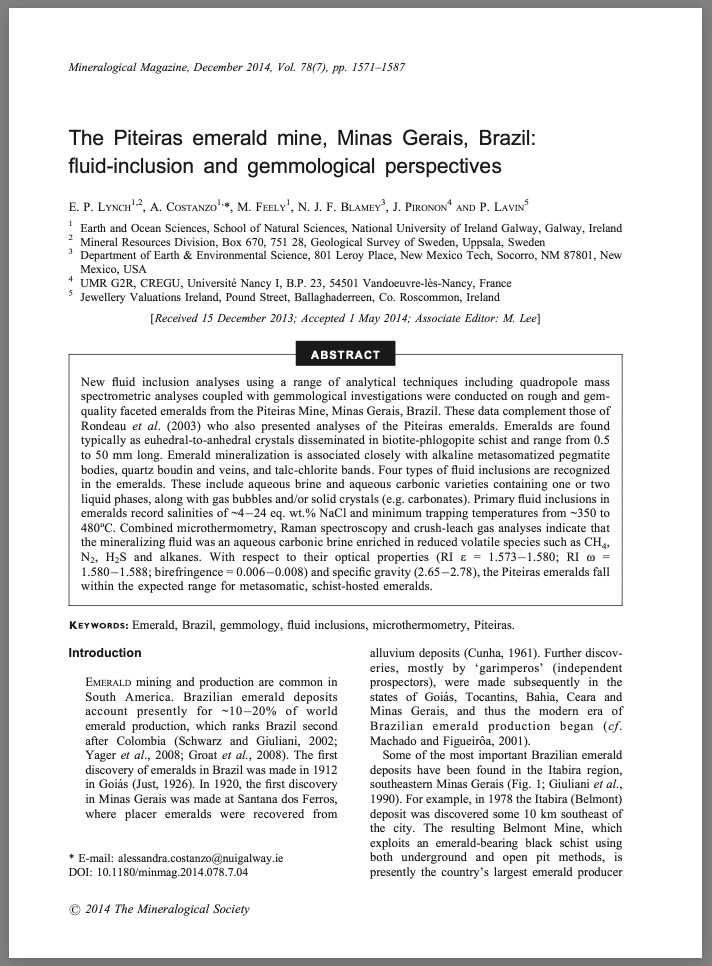
The Piteiras emerald mine, Minas Gerais, Brazil: Fluid-inclusion and gemmological perspectives
Journal Article
Lynch, E.P., Costanzo, A., Feely, M., Blamey, N.J.F., Pironon, J. and Lavin, P. (2014) The Piteiras emerald mine, Minas Gerais, Brazil: Fluid-inclusion and gemmological perspectives. Mineralogical Magazine, Vol. 78, No. 7, pp. 1571–1587.
ISBN/ISSN: 0026461X | DOI: https://doi.org/10.1180/minmag.2014.078.7.04 | Sinkankas/Born No.: NIS/NIB | RWHL
gems, Brazil, Emerald, Piteiras, fluid inclusions, gemology, provenance, microthermometry
New fluid inclusion analyses—using a range of techniques including quadrupole mass spectrometry coupled with gemmological investigations—were conducted on rough and gem-quality faceted emeralds from the Piteiras Mine, Minas Gerais, Brazil. These data complement those of Rondeau et al. (2003), who also studied emeralds from this locality. The emeralds typically occur as euhedral to anhedral crystals disseminated in biotite-phlogopite schist and range from 0.5 to 50 mm in length. Mineralization is closely associated with alkaline metasomatized pegmatite bodies, quartz boudins and veins, and talc-chlorite bands. Four types of fluid inclusions have been identified, including aqueous brine and aqueous carbonic inclusions containing one or two liquid phases, gas bubbles, and/or solid crystals such as carbonates. Primary fluid inclusions in the emeralds record salinities of approximately 4–24 equivalent wt.% NaCl and minimum trapping temperatures ranging from ~350 to 480 °C. Combined microthermometry, Raman spectroscopy, and crush-leach gas analyses reveal that the mineralizing fluid was an aqueous carbonic brine enriched in reduced volatile species such as CH₄, N₂, H₂S, and alkanes. In terms of optical properties (RI ε = 1.573–1.580; RI ω = 1.580–1.588; birefringence = 0.006–0.008) and specific gravity (2.65–2.78), the Piteiras emeralds fall within the expected range for metasomatic, schist-hosted emeralds.