
Four Treasures Reference Database
Record No. 27211
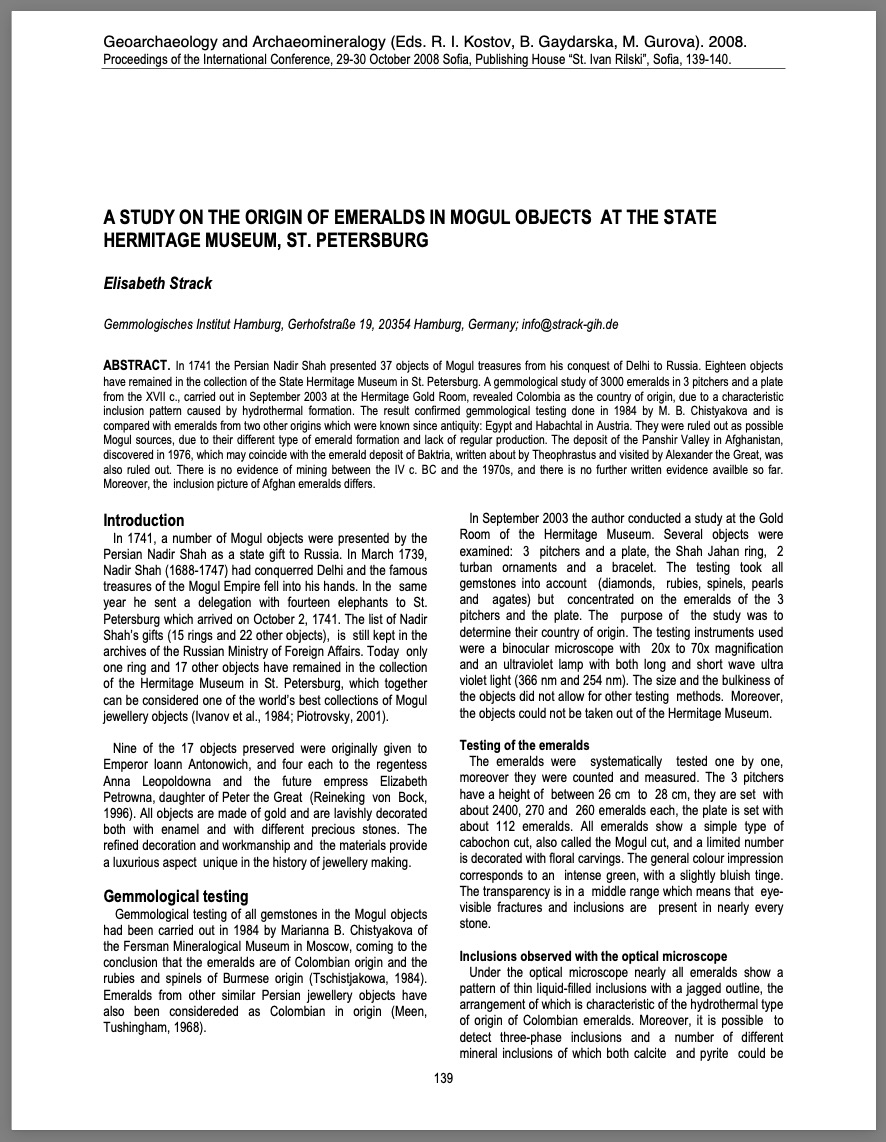
A study on the origin of emeralds in Mogul objects at the State Hermitage Museum, St. Petersburg
Conference Paper
Strack, E. (2008) A study on the origin of emeralds in Mogul objects at the State Hermitage Museum, St. Petersburg. Geoarchaeology and Archaeomineralogy | Proceedings of the International Conference, 29–30 October, Sofia: St. Ivan Rilski, pp. 139–140.
ISBN/ISSN: 9789540000000 | Sinkankas/Born No.: NIS/NIB | RWHL*
Close Abstract
Hide Keywords
Copy Reference
gems, beryl, emerald, Mughal emerald, Russia, Hermitage, St. Petersburg, historical emerald
In 1741 the Persian Nadir Shah presented 37 objects of Mogul treasures from his conquest of Delhi to Russia. Eighteen objects have remained in the collection of the State Hermitage Museum in St. Petersburg. A gemmological study of 3000 emeralds in 3 pitchers and a plate from the XVII c., carried out in September 2003 at the Hermitage Gold Room, revealed Colombia as the country of origin, due to a characteristic inclusion pattern caused by hydrothermal formation. The result confirmed gemmological testing done in 1984 by M. B. Chistyakova and is compared with emeralds from two other origins which were known since antiquity: Egypt and Habachtal in Austria. They were ruled out as possible Mogul sources, due to their different type of emerald formation and lack of regular production. The deposit of the Panjshir Valley in Afghanistan, discovered in 1976, which may coincide with the emerald deposit of Bactria, written about by Theophrastus and visited by Alexander the Great, was also ruled out. There is no evidence of mining between the IV c. BC and the 1970s, and there is no further written evidence available so far. Moreover, the inclusion picture of Afghan emeralds differs.