
Four Treasures Reference Database
Record No. 27223
Aspects of Roman mining in Noricum, Pannonia, Dalmatia and Moesia Superior
Book Section
Dušanić, S. (1977) Aspects of Roman mining in Noricum, Pannonia, Dalmatia and Moesia Superior. In: Band 6 Politische Geschichte (Provinzen und Randvölker: Lateinischer Donau-Balkanraum), Aufstieg und Niedergang der römischen Welt (ANRW) / Rise and Decline of the Roman World, pp. 52–94.
ISBN/ISSN: 9783110000000 | DOI: https://doi.org/10.1515/9783110852882-003 | Sinkankas/Born No.: NIS/NIB | RWHL
gems, ancient mining, Europe, archaeology, archaeogemology
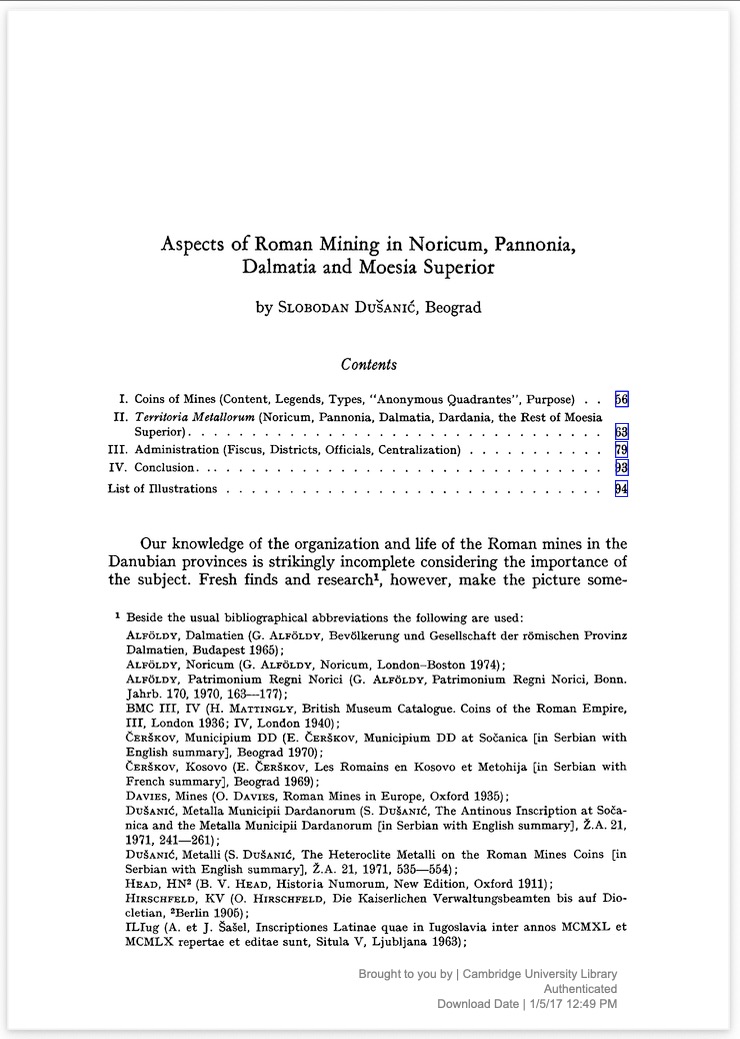
Our knowledge of the organization and life of the Roman mines in the Danubian provinces is strikingly incomplete considering the importance of the subject. Fresh finds and research, however, make the picture somewhat clearer; the following discussion concentrates on several points which, studied primarily on the basis of written sources, allow of a certain progress. The main conclusion of the present study is that Roman mining in the Danubian provinces—and, no doubt, also elsewhere—was more of a system than is commonly thought. That branch of industry demanded special care which exceeded the means of an area or a province, as illustrated by the transportations of peregrini from Dalmatia to Moesia Superior and Dacia for compulsory work in the mines. The hard fact that metals, especially precious ones, were both rare and needed, naturally led to the relative centralization of the mining administration, and to a distinction between the provinces which were rich in minerals and those which were not. Conceivably, such a state of affairs must have had manifold consequences. One of them should be stressed: the gradual municipalization of the provincial territory, which is a process common to all the Empire, was bound to affect the countries of central Noricum, southern Pannonia, northern Dalmatia, and almost the whole of Moesia Superior in a far lower degree, owing to the occurrence of mines within the vast fiscal domains. This had a bearing on all aspects of life there, notably on the organization of the portorium and on the degree of Romanization of the indigenous population.