
Four Treasures Reference Database
Record No. 27237
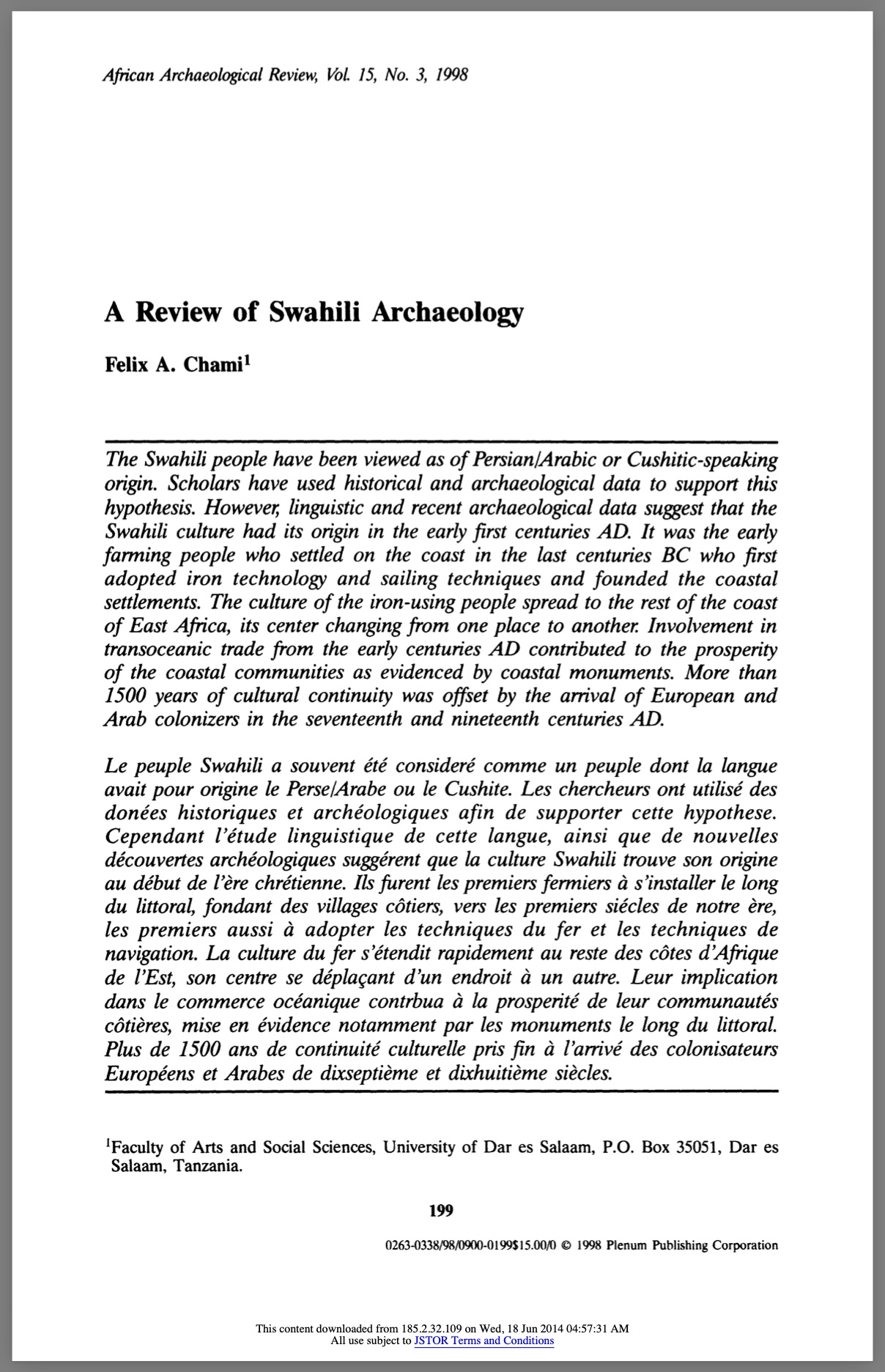
A review of Swahili archaeology
Journal Article
Chami, F.A. (1998) A review of Swahili archaeology. African Archaeological Review, Vol. 15, No. 3, pp. 199–221.
Sinkankas/Born No.: NIS / NIB | RWHL
gems, archaeology, archaeogemology, Africa, East Africa, Tanzania, Kenya
The Swahili people have been viewed as of Persian/Arabic or Cushitic-speaking origin. Scholars have used historical and archaeological data to support this hypothesis. However, linguistic and recent archaeological data suggest that the Swahili culture had its origin in the early first centuries AD. It was the early farming people who settled on the coast in the last centuries BC who first adopted iron technology and sailing techniques and founded the coastal settlements. The culture of the iron-using people spread to the rest of the coast of East Africa, its center changing from one place to another. Involvement in transoceanic trade from the early centuries AD contributed to the prosperity of the coastal communities as evidenced by coastal monuments. More than 1500 years of cultural continuity was offset by the arrival of European and Arab colonizers in the seventeenth and nineteenth centuries AD.