
Four Treasures Reference Database
Record No. 27239
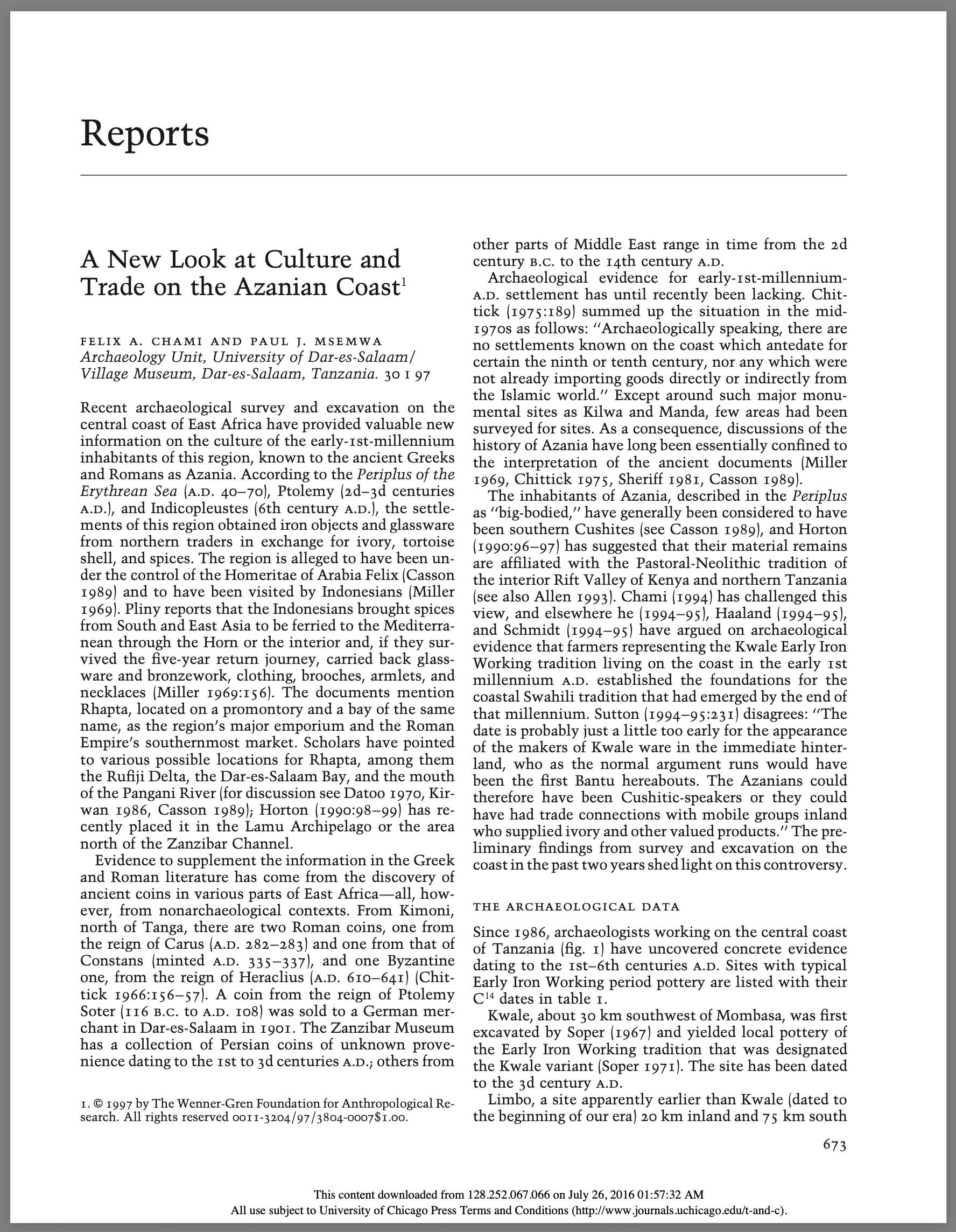
A new look at culture and trade on the Azanian coast
Journal Article
Chami, F.A. and Msemwa, P.J. (1997) A new look at culture and trade on the Azanian coast. Current Anthropology, Vol. 38, pp. 673–677.
gems, archaeology, archaeogemology, Africa, East Africa, Tanzania, Kenya
Recent archaeological survey and excavation on the central coast of East Africa have provided valuable new information on the culture of the early-1st-millennium inhabitants of this region, known to the ancient Greeks and Romans as Azania. According to the Periplus of the Erythrean Sea (A.D. 40–70), Ptolemy (2d–3d centuries A.D.), and Indicopleustes (6th century A.D.), the settlements of this region obtained iron objects and glassware from northern traders in exchange for ivory, tortoise shell, and spices. The region is alleged to have been under the control of the Homeritae of Arabia Felix (Casson 1989) and to have been visited by Indonesians (Miller 1969). Pliny reports that the Indonesians brought spices from South and East Asia to be ferried to the Mediterranean through the Horn or the interior and, if they survived the five-year return journey, carried back glassware and bronzework, clothing, brooches, armlets, and necklaces (Miller 1969:156). The documents mention Rhapta, located on a promontory and a bay of the same name, as the region’s major emporium and the Roman Empire’s southernmost market. Scholars have pointed to various possible locations for Rhapta, among them the Rufiji Delta, the Dar-es-Salaam Bay, and the mouth of the Pangani River (for discussion see Datoo 1970, Kirwan 1986, Casson 1989); Horton (1990:98–99) has recently placed it in the Lamu Archipelago or the area north of the Zanzibar Channel.