
Four Treasures Reference Database
Record No. 27275
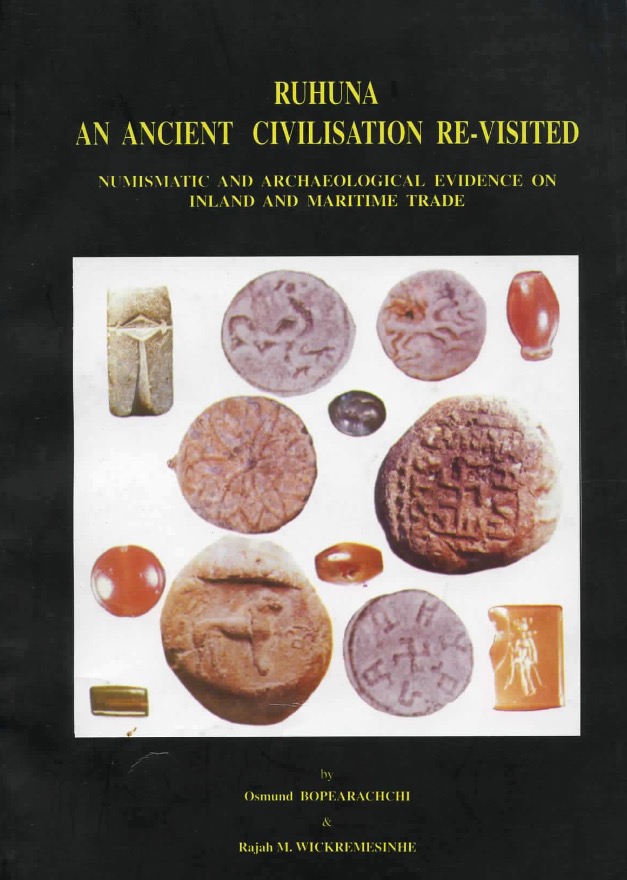
Ruhuna. An Ancient Civilisation Re-visited. Numismatic and Archaeological Evidence on Inland and Maritime Trade
Book
Bopearachchi, O., de and Wickremesinghe, R.M. (1999) Ruhuna. An Ancient Civilisation Re-visited. Numismatic and Archaeological Evidence on Inland and Maritime Trade. Colombo, French Mission of Archaeological Co-operation in Sri Lanka, 140 pp., 36 plates
Sinkankas/Born No.: NIS/NIB | RWHL
gems, archaeology, archaeogemology, India, Sri Lanka, Tamil Nadu, South India
My interest in numismatics began when, as a child, I received a gift of some coins from my father. As an accomplished athlete at National level, my primary interest, however, was in sports. In 1965, whilst serving in the then Royal Ceylon Air Force, an injury caused by an accident on the sports field kept me away from any sports participation for two years. During this period I revived my interest in numismatics, which soon became a passion. My coin collecting had until then been very amateurish. It was the late Ronnie Schrader, the foremost collector I had met, who created in me an interest in the ancient period of Sri Lanka. The late A. A. de Silva of Galle, the late Haji A. W. M. Noor Hameem, the late John, and Mr. Somapala of Colombo Fort were my earliest suppliers of coins, while Mr. A. Ratnayake of Tissamaharama assisted me in obtaining items from Ruhuna. T. M. de Silva Abeywardena’s Price Catalogue of Ancient Coins of Ceylon published in 1952, and H. W. Codrington’s Ceylon Coins and Currency published in 1924 were my earliest reference guides. Most collectors purchased coins from traders who in actual fact were owners of small jewellery shops scattered throughout the country. These shops had until 1971 obtained their coins through middlemen who roamed the villages for parana badu (old items of intrinsic value). Most of the coins in gold and silver were then melted down to meet their immediate needs of raw material for manufacturing jewellery. Any coins in these two precious metals were spared only if the shop had a customer who was a collector, visiting them at least once in three months. Such coins were sold to collectors at a little over the prevailing intrinsic value. Copper coins invariably remained intact, and could often be seen displayed in trays or glass cabinets at the entrance to such shops.