
Four Treasures Reference Database
Record No. 27308
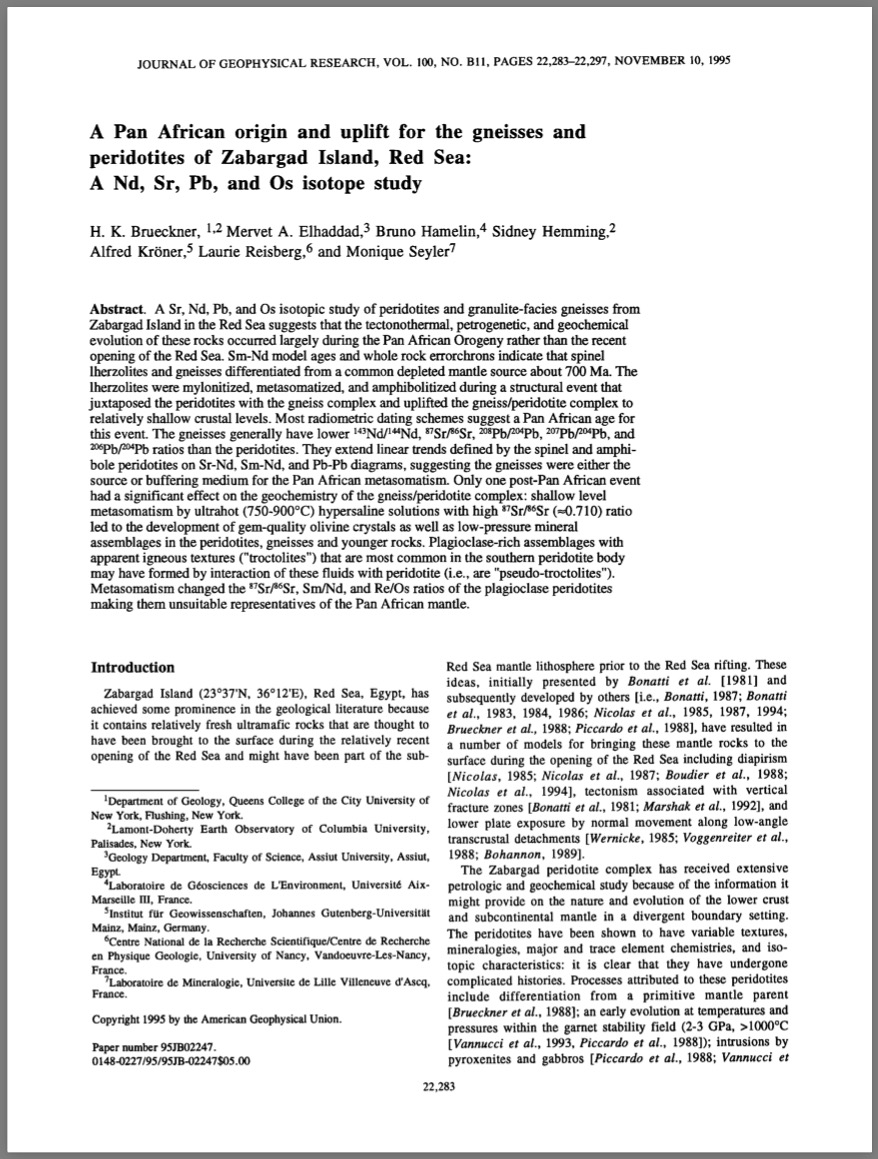
A Nd, Sr, Pb and Os study of the gneisses and ultramafic rocks of Zabargad Isand, Red Sea: Miocene Moho or Pan African peridotites
Journal Article
Brueckner, H.K., Elhaddad, M.A., Hamelin, B., Hemming, S., Kröner, A., Reisberg, L. and Seyler, M. (1996) A Nd, Sr, Pb and Os study of the gneisses and ultramafic rocks of Zabargad Isand, Red Sea: Miocene Moho or Pan African peridotites. Journal of Geophysical Research, Vol. 100, No. B11, pp. 22283–22297.
gems, analytical, geology, Red Sea, Saudi Arabia, olivine basalts, Eritrea, Ethiopia
A Sr, Nd, Pb, and Os isotopic study of peridotites and granulite-facies gneisses from Zabargad Island in the Red Sea suggests that the tectonothermal, petrogenetic, and geochemical evolution of these rocks occurred largely during the Pan African Orogeny rather than the recent opening of the Red Sea. Sm-Nd model ages and whole rock errorchrons indicate that spinel lherzolites and gneisses differentiated from a common depleted mantle source about 700 Ma. The lherzolites were mylonitized, metasomatized, and amphibolitized during a structural event that juxtaposed the peridotites with the gneiss complex and uplifted the gneiss/peridotite complex to relatively shallow crustal levels. Most radiometric dating schemes suggest a Pan African age for this event. The gneisses generally have lower ¹⁴³Nd/¹⁴⁴Nd, ⁸⁷Sr/⁸⁶Sr, ²⁰⁸Pb/²⁰⁴Pb, ²⁰⁷Pb/²⁰⁴Pb, and ²⁰⁶Pb/²⁰⁴Pb ratios than the peridotites. They extend linear trends defined by the spinel and amphibole peridotites on Sr-Nd, Sm-Nd, and Pb-Pb diagrams, suggesting the gneisses were either the source or buffering medium for the Pan African metasomatism. Only one post-Pan African event had a significant effect on the geochemistry of the gneiss/peridotite complex: shallow level metasomatism by ultrahot (750–900 °C) hypersaline solutions with high ⁸⁷Sr/⁸⁶Sr (≈ 0.710) ratio led to the development of gem-quality olivine crystals as well as low-pressure mineral assemblages in the peridotites, gneisses and younger rocks. Plagioclase-rich assemblages with apparent igneous textures (“troctolites”) that are most common in the southern peridotite body may have formed by interaction of these fluids with peridotite (i.e., are “pseudo-troctolites”). Metasomatism changed the ⁸⁷Sr/⁸⁶Sr, Sm/Nd, and Re/Os ratios of the plagioclase peridotites making them unsuitable representatives of the Pan African mantle.