
Four Treasures Reference Database
Record No. 27310
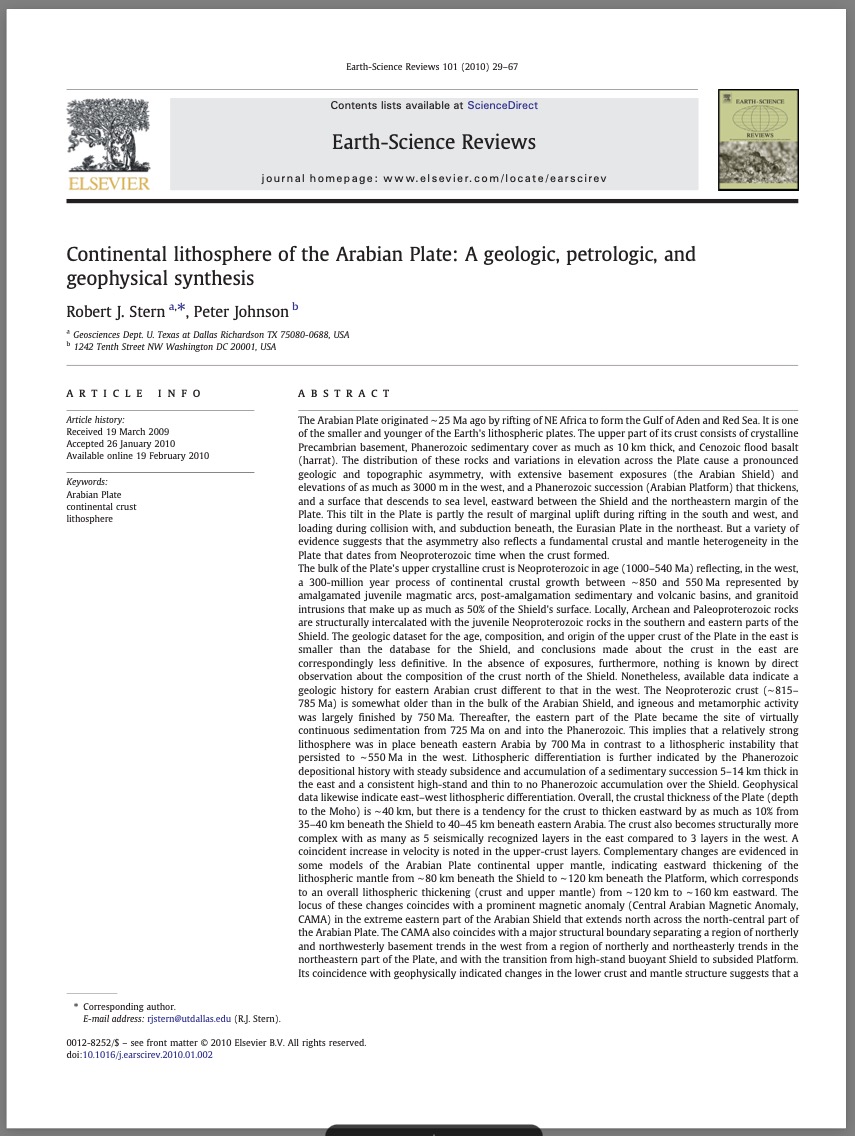
Continental lithosphere of the Arabian Plate: A geologic petrologic, and geophysical synthesis
Journal Article
Stern, R.J. and Johnson, P. (2010) Continental lithosphere of the Arabian Plate: A geologic petrologic, and geophysical synthesis. Earth-Sciences Reviews, Vol. 101, pp. 29–67.
gems, analytical, geology, Red Sea, Saudi Arabia, olivine basalts, Eritrea, Ethiopia, Yemen, peridotites
The Arabian Plate originated ∼25 Ma ago by rifting of NE Africa to form the Gulf of Aden and Red Sea. It is one of the smaller and younger of the Earth’s lithospheric plates. The upper part of its crust consists of crystalline Precambrian basement, Phanerozoic sedimentary cover as much as 10 km thick, and Cenozoic flood basalt (harrat). The distribution of these rocks and variations in elevation across the Plate cause a pronounced geologic and topographic asymmetry, with extensive basement exposures (the Arabian Shield) and elevations of as much as 3000 m in the west, and a Phanerozoic succession (Arabian Platform) that thickens, and a surface that descends to sea level, eastward between the Shield and the northeastern margin of the Plate. This tilt in the Plate is partly the result of marginal uplift during rifting in the south and west, and loading during collision with, and subduction beneath, the Eurasian Plate in the northeast. But a variety of evidence suggests that the asymmetry also reflects a fundamental crustal and mantle heterogeneity in the Plate that dates from Neoproterozoic time when the crust formed.