
Four Treasures Reference Database
Record No. 27313
Petrology of mantle xenoliths from Harrat al Kishb: The mantle beneath western Saudi Arabia
Journal Article
McGuire, A.W. (1988) Petrology of mantle xenoliths from Harrat al Kishb: The mantle beneath western Saudi Arabia. Technophysics, Vol. 150, pp. 101–119.
gems, analytical, geology, Red Sea, Saudi Arabia, olivine basalts, Eritrea, Ethiopia, Yemen, peridotites
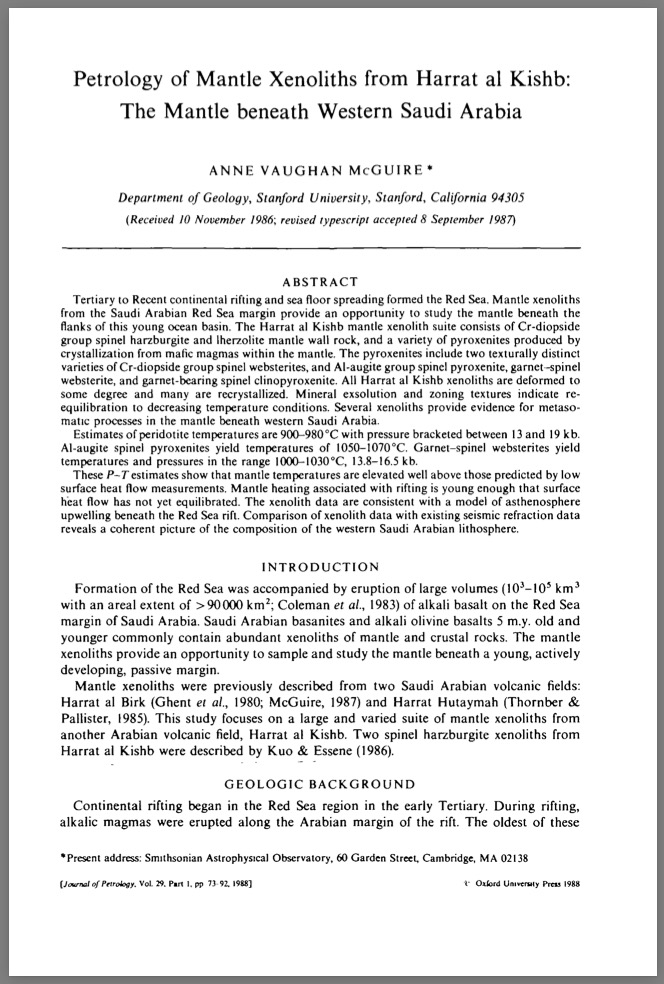
Tertiary to Recent continental rifting and sea floor spreading formed the Red Sea. Mantle xenoliths from the Saudi Arabian Red Sea margin provide an opportunity to study the mantle beneath the flanks of this young ocean basin. The Harrat al Kishb mantle xenolith suite consists of Cr-diopside group spinel harzburgite and lherzolite mantle wall rock, and a variety of pyroxenites produced by crystallization from mafic magmas within the mantle. The pyroxenites include two texturally distinct varieties of Cr-diopside group spinel websterites, and Al-augite group spinel pyroxenite, garnet-spinel websterite, and garnet-bearing spinel clinopyroxenite. All Harrat al Kishb xenoliths are deformed to some degree and many are recrystallized. Mineral exsolution and zoning textures indicate reequilibration to decreasing temperature conditions. Several xenoliths provide evidence for metasomatic processes in the mantle beneath western Saudi Arabia. Estimates of peridotite temperatures are 900–980 °C with pressure bracketed between 13 and 19 kb. Al-augite spinel pyroxenites yield temperatures of 1050–1070 °C. Garnet-spinel websterites yield temperatures and pressures in the range 1000–1030 °C, 13.8–16.5 kb. These P–T estimates show that mantle temperatures are elevated well above those predicted by low surface heat flow measurements. Mantle heating associated with rifting is young enough that surface heat flow has not yet equilibrated. The xenolith data are consistent with a model of asthenosphere upwelling beneath the Red Sea rift. Comparison of xenolith data with existing seismic refraction data reveals a coherent picture of the composition of the western Saudi Arabian lithosphere.