
Four Treasures Reference Database
Record No. 27335
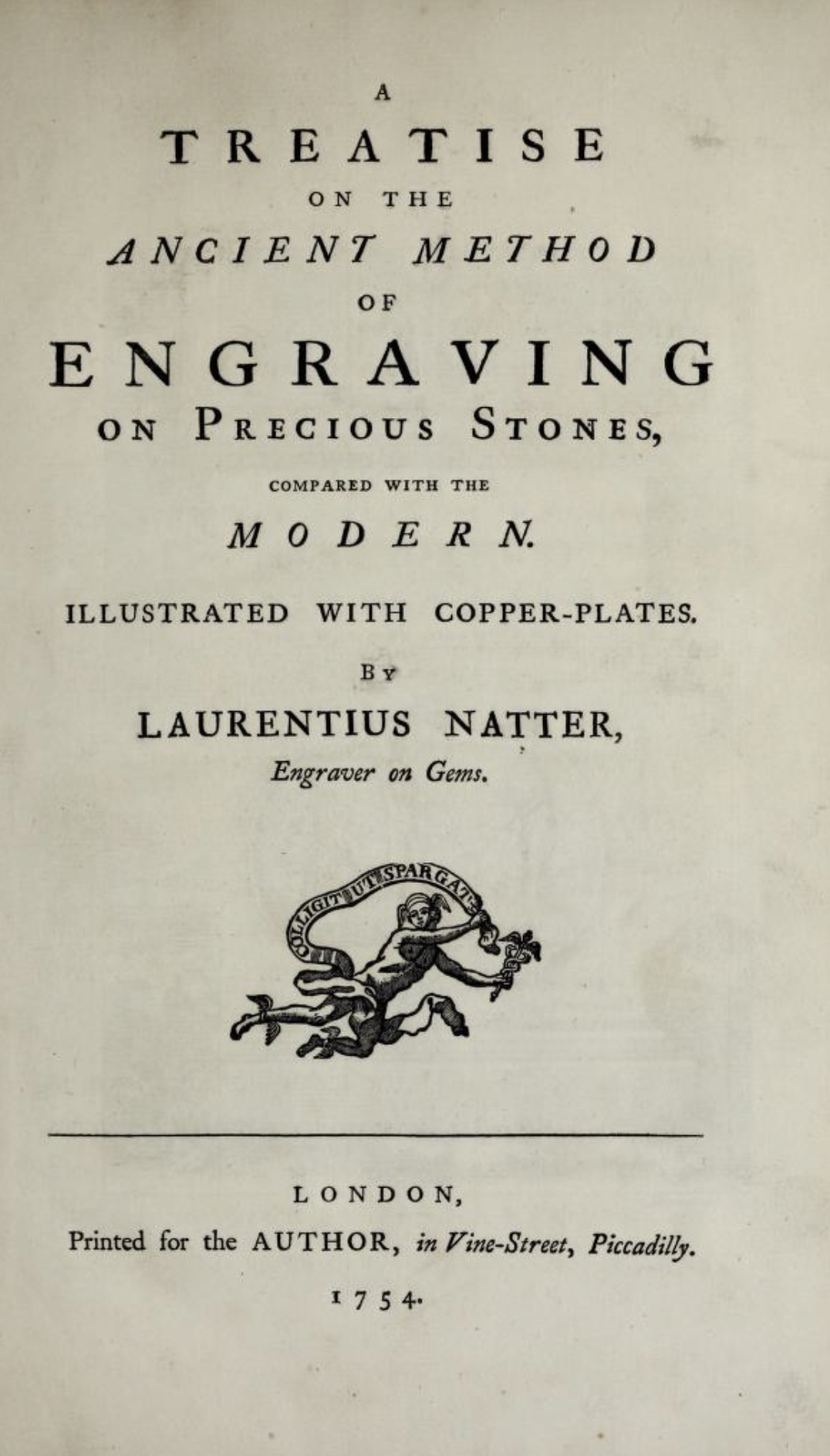
A Treatise on the Ancient Method of Engraving on Precious Stones, Compared with the Modern
Book
Natter, L. (1754) A Treatise on the Ancient Method of Engraving on Precious Stones, Compared with the Modern. London, self published, 54 + xxxvi pp.
Sinkankas/Born No.: 1420 (not seen)/NIB | RWHL
gems, glyptic, engraved gems, agate, cameo, intaglio
Sinkankas: This famous book, the only publication of its importance by the author, is the first to attempt an explanation of the accessories, materials, and methods employed in the carving of engraved gems. The lengthy preface treats many topics such as the history of the engraver’s art, opinions on certain of the ancient gems, their personal marks, contemporary artists and their materials, gems, etc. The first four plates depict the tools of the engraver and the steps required to carve intaglios and are inserted in the text section dealing with this phase of work. The rest of the book shows examples of engraved gems on plates with descriptions in the text. Each description indicates actual size (plate figures are greatly enlarged), owner, and other data. While many hail this work as explaining the “secrets” of the art, the facts are that crucial details on how one goes about making the carving points and charging them with diamond, or how the latter is procured and processed, as well as other details necessary to ensure success, are all glossed over—one suspects more for preservation of the real secrets of the art rather than inability of the author to explain them. Nevertheless, for one wanting to engrave gems, this book must have offered considerable help and certainly was far better than nothing. C.W. King, Antique Gems and Rings, I, 435–6 (1872), provides a brief sketch of Natter’s career and works, but with erroneous date and title, and cites this work as “excessively scarce.” Further, p. 466–7, he states that it is “valuable giving the practical experience of one of the greatest of the modern practitioners of the art, and illustrated with 37 plates tolerably executed. Some of them, however, are particularly interesting, as they are given to illustrate the progressive steps by which this artist effected his most important copies of celebrated antiques.” Furtwängler, Die antiken Gemmen, III, 1900, 414, “contains fairly good drawings of 34 antique and 3 modern gems.” Natter’s ability to meticulously copy antique gems—and the often unscrupulous disposal of such sold gems as genuine—is touched upon in Billing’s The Science of Gems, 1875, 82, where acid comments on such gems sold by the “arch-humbug dealer, Baron Stosch,” enliven the text. Of the two editions, the English is far more difficult to obtain although both are truly rare. See also comments of the Zazoffs, Gemmensammler, 1983, 128–30.