
Four Treasures Reference Database
Record No. 27337
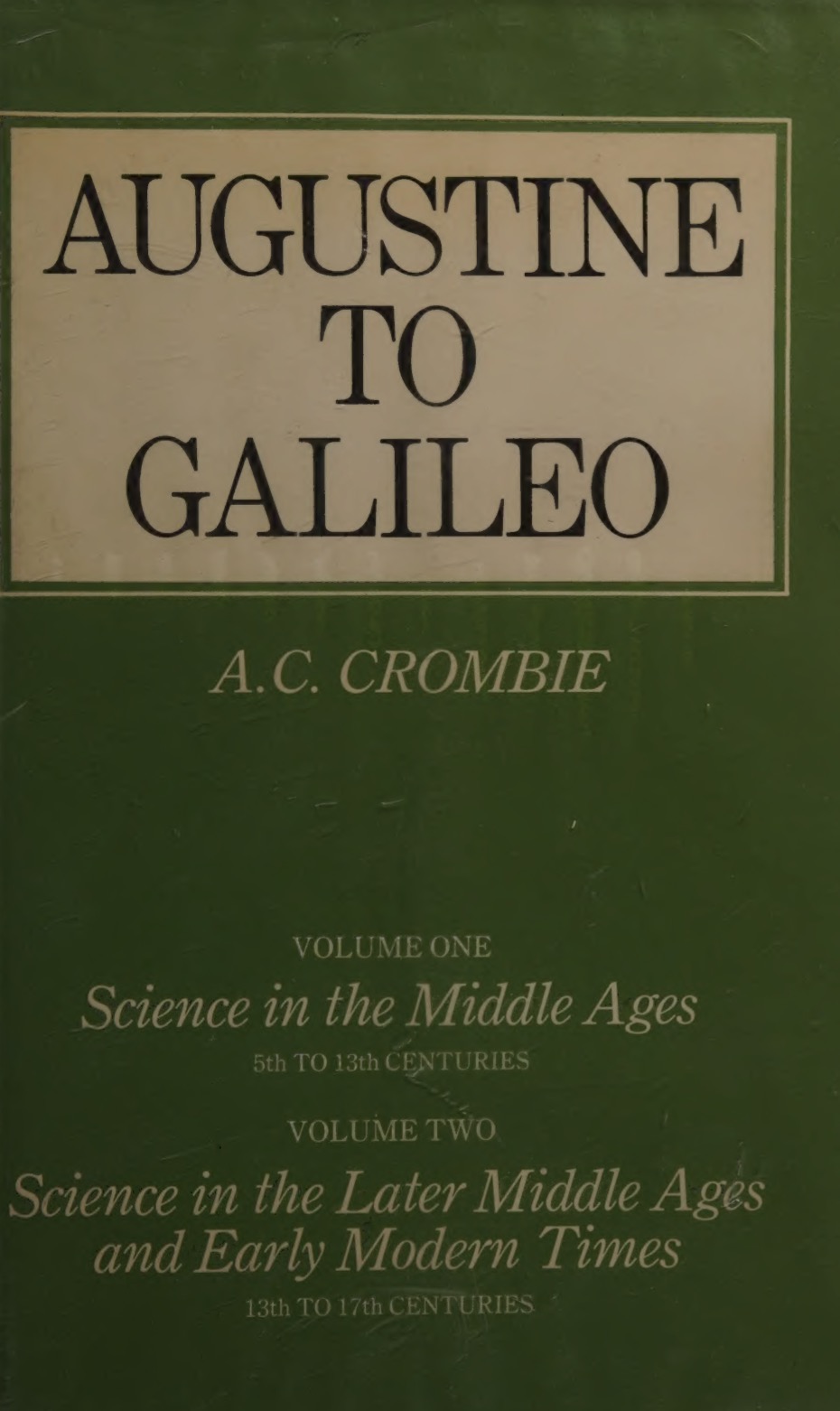
Augustine to Galileo | The History of Science | A.D. 400–1650
Book
Crombie, A.C. (1952) Augustine to Galileo | The History of Science | A.D. 400–1650. London, Heinemann, 2 Vols.
ISBN/ISSN: 435541943 | Sinkankas/Born No.: NIS/NIB | RWHL
gems, history of gemology, history of mineralogy, Arabic mineralogy, history of science, Egypt, Rome, Greek science, astronomy
On its first publication in 1952, Augustine to Galileo was widely welcomed as having ‘removed for ever any excuse there may have been for ignorance of medieval scientific thought’. The book has since become a standard work, and the second (revised and enlarged) edition is now reissued with further corrections. Medieval scientific thought is deceptive both in its similarities to and in its differences from modern science. It was a series of actions in the great adventure of philosophical reformation that separates the classical world from our own. In the course of that adventure, as at all times in the history of science, one system of scientific thought gave place to another not merely because new facts were discovered, but more significantly because men began to ask new questions, to look at long-familiar evidence in a new way. Not only the origins but the nature of modern science can scarcely be understood without a knowledge of the period covered by this book. Dr. Crombie begins with an account of the remains of those Greek scientific conceptions found in the West after the fall of Rome, and of the new ideas about the natural world introduced with Christianity. He then traces the process of the recovery of Greek science from Byzantium and Islam, the assimilation of the new knowledge in the Latin West, the parallel development of technology, and the new conception of experimental science that was formed in the thirteenth and fourteenth centuries. The shifts in scientific thinking in the later Middle Ages emerge as a product of the empiricism of technology married to the methods of rational abstraction of mathematics and philosophy. These shifts prepared the ground for the final revolution brought about by Galileo and his contemporaries. A consideration of their work brings the author to his conclusion. Dr. Crombie is one of the most outstanding historians of science, and is University Lecturer in the History of Science at Oxford.