
Four Treasures Reference Database
Record No. 27342
Ancient murrhine ware and its glass evocation
Journal Article
Tressaud, A. and Vickers, M. (2007) Ancient murrhine ware and its glass evocation. Journal of Glass Studies, Vol. 49, pp. 143–152.
Sinkankas/Born No.: NIS/NIB | RWHL
gems, archaeology, archaeogemology, Greece, Rome, murrina, fluorite, Egypt
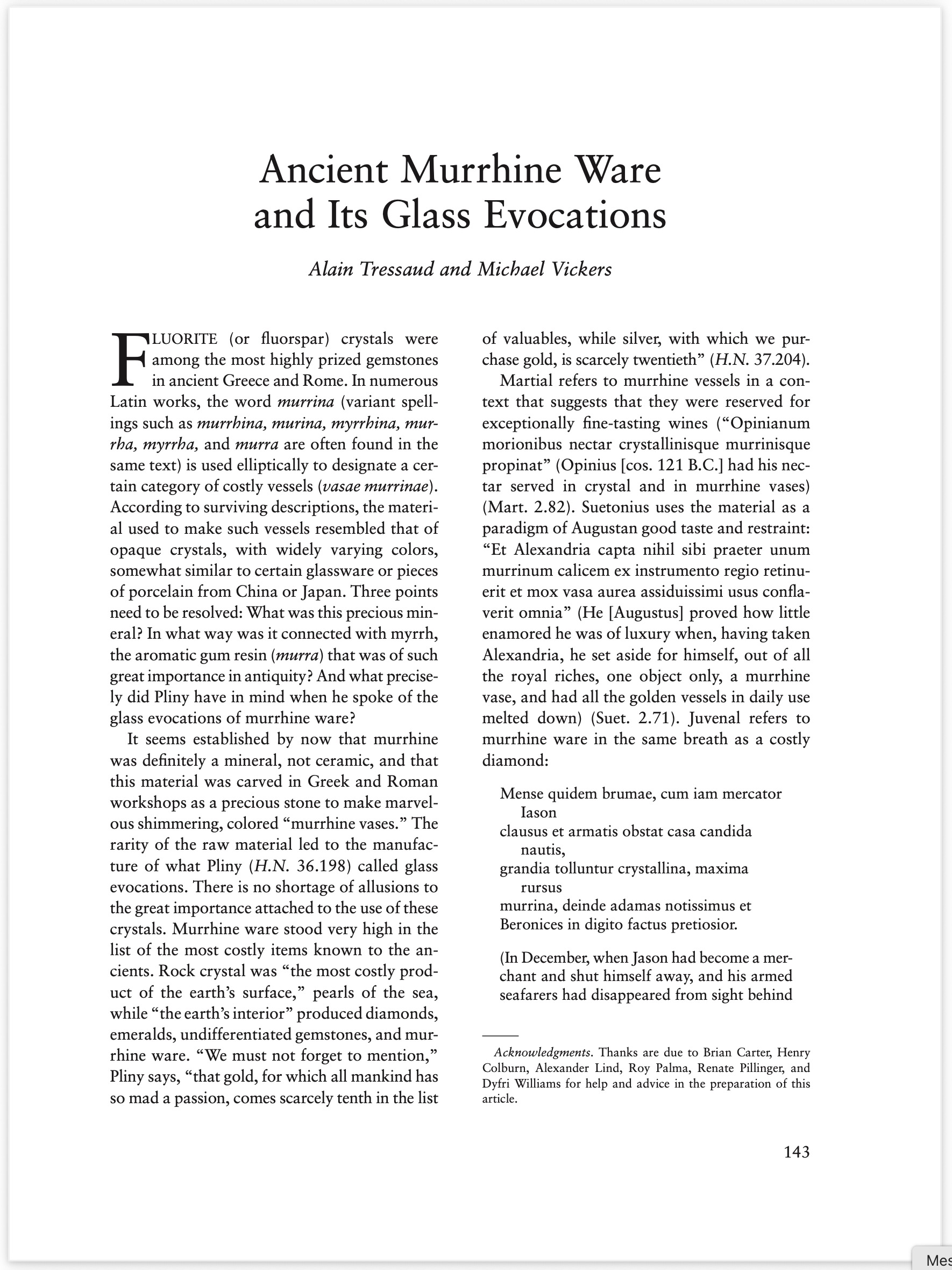
Fluorite (or fluorspar) crystals were among the most highly prized gemstones in ancient Greece and Rome. In numerous Latin works, the word murrina (with variant spellings such as murrhina, murina, myrrhina, murrha, myrrha, and murra often appearing within the same text) is used elliptically to designate a certain category of costly vessels (vasae murrinae). According to surviving descriptions, the material used to make such vessels resembled that of opaque crystals, with widely varying colors, somewhat similar to certain glassware or pieces of porcelain from China or Japan. Three points need to be resolved: What was this precious mineral? In what way was it connected with myrrh, the aromatic gum resin (murra) that was of such great importance in antiquity? And what precisely did Pliny have in mind when he spoke of the glass evocations of murrhine ware? It seems established by now that murrhine was definitely a mineral, not ceramic, and that this material was carved in Greek and Roman workshops as a precious stone to make marvelous shimmering, colored “murrhine vases.” The rarity of the raw material led to the manufacture of what Pliny (H.N. 36.198) called glass evocations. There is no shortage of allusions to the great importance attached to the use of these crystals. Murrhine ware stood very high in the list of the most costly items known to the ancients. Rock crystal was “the most costly product of the earth’s surface,” pearls of the sea, while “the earth’s interior” produced diamonds, emeralds, undifferentiated gemstones, and murrhine ware. “We must not forget to mention,” Pliny says, “that gold, for which all mankind has so mad a passion, comes scarcely tenth in the list of valuables, while silver, with which we purchase gold, is scarcely twentieth” (H.N. 37.204).