
Four Treasures Reference Database
Record No. 27377
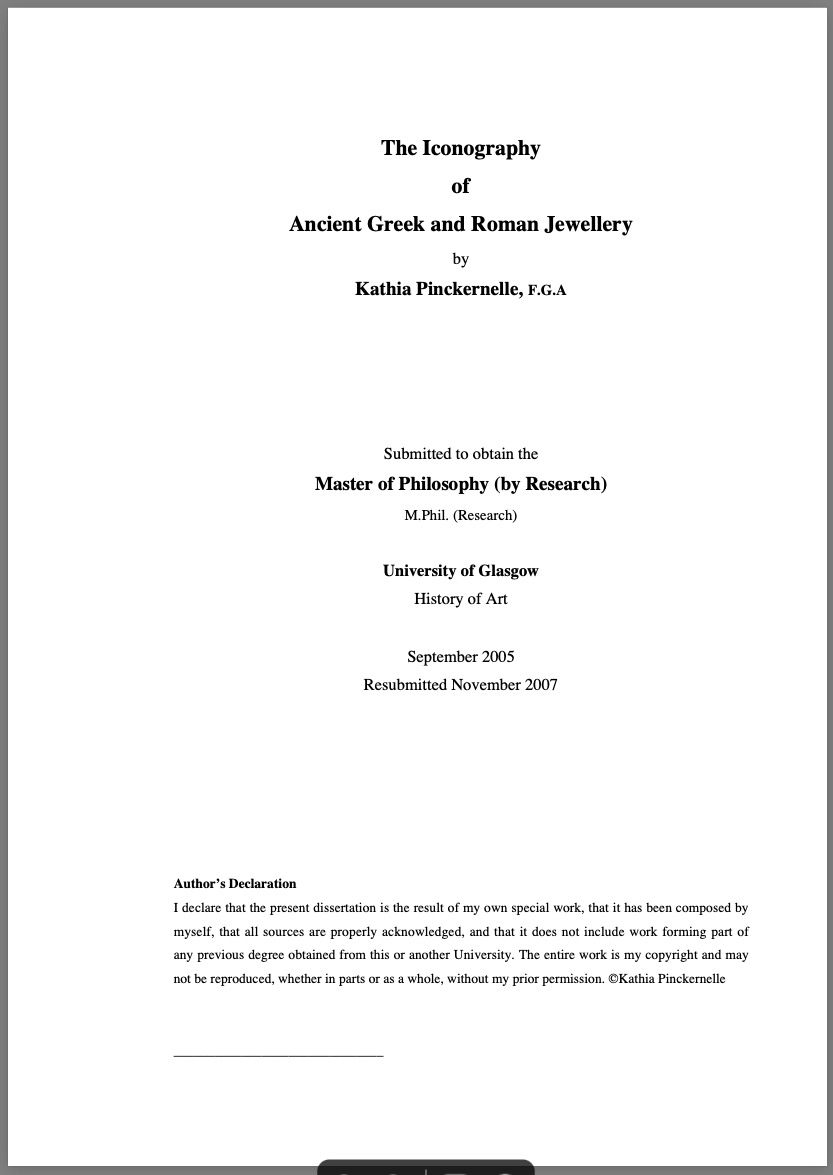
The Iconography of Ancient Greek and Roman Jewellery
Thesis
Pinckernelle, K. (2007) The Iconography of Ancient Greek and Roman Jewellery. University of Glasgow, 131 pp.
Sinkankas/Born No.: NIS/NIB | RWHL
gems, glyptic, engraved gems, agate, cameo, intaglio, Greece, Greek, Roman, Egypt, iconography, garnet
This work will examine the various forms of symbolism and iconography in jewellery from ancient Greece and Rome. It sets out to elucidate and place into the appropriate cultural context the motifs represented in jewellery from these civilisations. The work is largely divided into three parts. The first part, itself divided into sections dedicated to Greece (with Etruria as an afterthought) and Rome respectively, discusses the symbolism and iconography by introducing the most important deities and making the connection between them and the motifs occurring in jewellery. Naturally, a selection had to be made regarding the motifs: although the aim is to give a fairly broad overview and include more than just the most standard motifs, the examination cannot, for obvious reasons, extend to designs only singularly occurring in jewellery. It follows that the list of motifs discussed is by no means exhaustive, yet some rarely ever examined motifs such as the tortoise, for example, are given space for consideration. The second part applies the above to a selection of extant jewellery. Each plate is critically described to draw together some of the conclusions of the first part in practical terms and to point at parallels if applicable. In the third part, some new interpretations are considered. Deriving largely from the findings of the first part, the identity of some motifs in particular can be newly identified (for example certain pomegranate or fennel seed pendants), while some jewels are looked at with a fresh interpretation.