
Four Treasures Reference Database
Record No. 27445
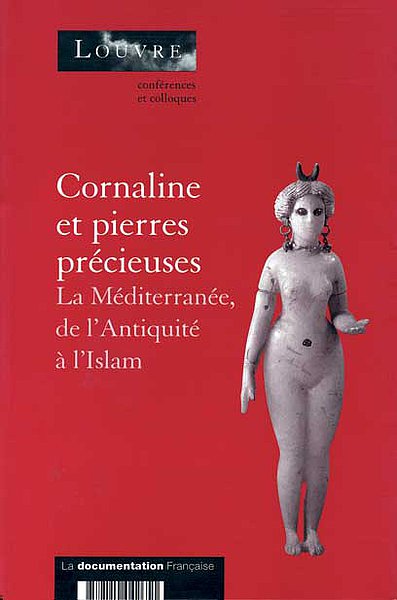
Les rubis d’Ishtar: Étude en laboratoire
The rubies of Ishtar: Laboratory study
Book Section
Calligaro, T., Bouquillon, A., Querré, G. and Poirot, J.-P. (1999) Les rubis d’Ishtar: Étude en laboratoire. [The rubies of Ishtar: Laboratory study] In: Cornaline et pierres precieuses, La Mediterranee de l'Antiquité a l’Islam, Paris: Louvre éditions, pp. 211–227.
ISBN/ISSN: 9782110000000 | Sinkankas/Born No.: NIS/NIB | Language: in French | RWHL
corundum, History.1, gems
One of the advantages of an exhibition is the opportunity to view overly familiar objects with fresh eyes—objects that had not previously been questioned—and to benefit from the observations of specialists whose attention has been drawn to particular details. We are therefore very grateful to Mr. Staf Van Roy, director of the Laboratory of the Historical Gemmology Association in Brussels, for pointing out to us that the inlays on a Babylonian alabaster figurine from the Parthian period, generally considered to be garnets, must in fact be rubies, and for confirming this after examination. This identification is what prompted research by the Laboratory of the Museums of France. The statuette (fig. 1) comes from a tomb discovered by Pacifique Delaporte, French consul in Baghdad, while traveling from Babylon to Hillah during a journey undertaken in October 1862. It entered the Louvre in 1866 and was published by François Lenormant in 1876; it has been reproduced many times since. Thanks to a detailed report sent by Delaporte on January 21, 1863, to the Minister of Foreign Affairs—mentioned and partially reproduced by Léon Heuzey—we are well informed about the circumstances of its discovery. It is therefore clear that all the evidence seems to point to a date between 100 BCE and the end of the 1st century CE. Moreover, the existence of a tomb of such quality is more easily explained before the decline of the city, which is attested from the beginning of the 2nd century CE. But regardless of the exact moment when this exceptional object was made, it seems in any case to offer us the earliest attestation of the use of rubies in the Middle East. Their presence confirms the popularity, during the Parthian period, of red stones from the distant East: almandine garnets imported from India or Sri Lanka, which appeared first in Mesopotamia—as some were buried beneath the foundations of the gates of Khorsabad in the 8th century BCE—but also red spinel, which adorns jewelry from Hatra in the 2nd century CE and early 3rd century. However, the presence of these rubies originating from Burma shows that trade, around the beginning of our era, reached increasingly distant regions, allowing true precious stones to make their way to Mesopotamia.