
Four Treasures Reference Database
Record No. 27499
East-West knowledge transfer in Mughal India: An Arabic Translation of Clavius
Web Page
Sobers-Khan, N. (2013) East-West knowledge transfer in Mughal India: An Arabic Translation of Clavius. British Library, <https://blogs.bl.uk/asian-and-african/2013/02/east-west-knowledge-transfer-in-mughal-india.html>, accessed: 29 June 2025.
Sinkankas/Born No.: NIS/NIB | RWHL
gems, history of science, calendar development
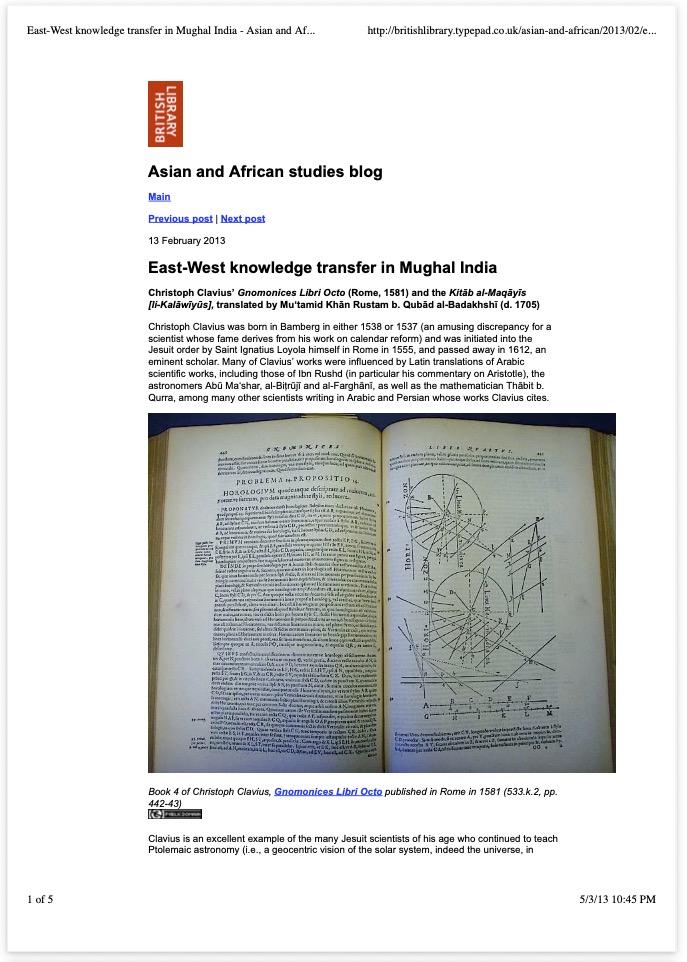
Christoph Clavius’ Gnomonices Libri Octo (Rome, 1581) and the Kitāb al-Maqāyīs [li-Kalāwīyūs], translated by Mu‘tamad Khān Rustam b. Qubād al-Badakhshī (d. 1705). Christoph Clavius was born in Bamberg in either 1538 or 1537 (an amusing discrepancy for a scientist whose fame derives from his work on calendar reform) and was initiated into the Jesuit order by Saint Ignatius Loyola himself in Rome in 1555, and passed away in 1612, an eminent scholar. Many of Clavius’ works were influenced by Latin translations of Arabic scientific works, including those of Ibn Rushd (in particular his commentary on Aristotle), the astronomers Abū Ma‘shar, al-Biṭrūjī and al-Farghānī, as well as the mathematician Thābit b. Qurra, among many other scientists writing in Arabic and Persian whose works Clavius cites.