
Four Treasures Reference Database
Record No. 27511
Gemmology in the service of archaeometry
Book Section
Riccardi, M.P., Prosperi, L., Tarantino, S.C. and Zema, M. (2019) Gemmology in the service of archaeometry. In: EMU Notes in Mineralogy, Vol. 20, Chapter 9 , pp. 345–366.
Sinkankas/Born No.: NIS/NIB | RWHL
gems, ancient gemology, ancient jewelry, advanced testing, archaeology, archaeogemology, garnet, corundum, sapphire, quartz, amethyst, glass, manmade glass, Libyan desert glass
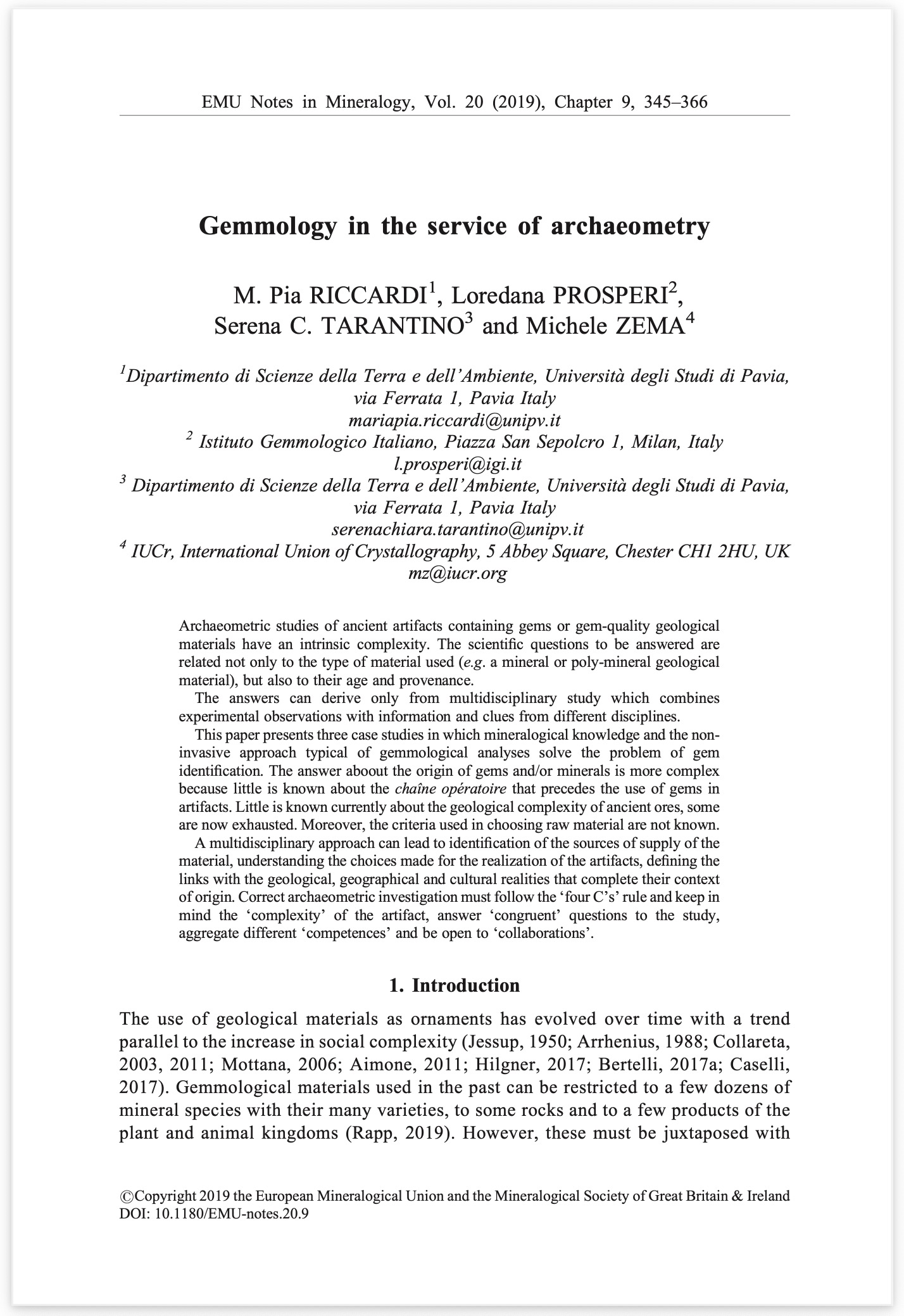
Archaeometric studies of ancient artifacts containing gems or gem-quality geological materials have an intrinsic complexity. The scientific questions to be answered are related not only to the type of material used (e.g. a mineral or poly-mineral geological material), but also to their age and provenance. The answers can derive only from multidisciplinary study which combines experimental observations with information and clues from different disciplines. This paper presents three case studies in which mineralogical knowledge and the non-invasive approach typical of gemmological analyses solve the problem of gem identification. The answer about the origin of gems and/or minerals is more complex because little is known about the chaîne opératoire that precedes the use of gems in artifacts. Little is known currently about the geological complexity of ancient ores, some are now exhausted. Moreover, the criteria used in choosing raw material are not known. A multidisciplinary approach can lead to identification of the sources of supply of the material, understanding the choices made for the realization of the artifacts, defining the links with the geological, geographical and cultural realities that complete their context of origin. Correct archaeometric investigation must follow the ‘four C’s’ rule and keep in mind the ‘complexity’ of the artifact, answer ‘congruent’ questions to the study, aggregate different ‘competences’ and be open to ‘collaborations’.