
Four Treasures Reference Database
Record No. 27523
Roman wheel-cut engraving, dyeing and painting microquartz gemstones
Journal Article
Rosenfeld, A., Dvorachek, M. and Amorai-Stark, S. (2003) Roman wheel-cut engraving, dyeing and painting microquartz gemstones. Journal of Archaeological Science, Vol. 30, No. 2, pp. 227–238.
ISBN/ISSN: 3054403 | DOI: https://doi.org/10.1006/jasc.2002.0829 | Sinkankas/Born No.: NIS/NIB | RWHL
gems, engravings, microquartz, Roman period, chemical analysis, abrasives, lubricant agents, dyeing, painting, quartz
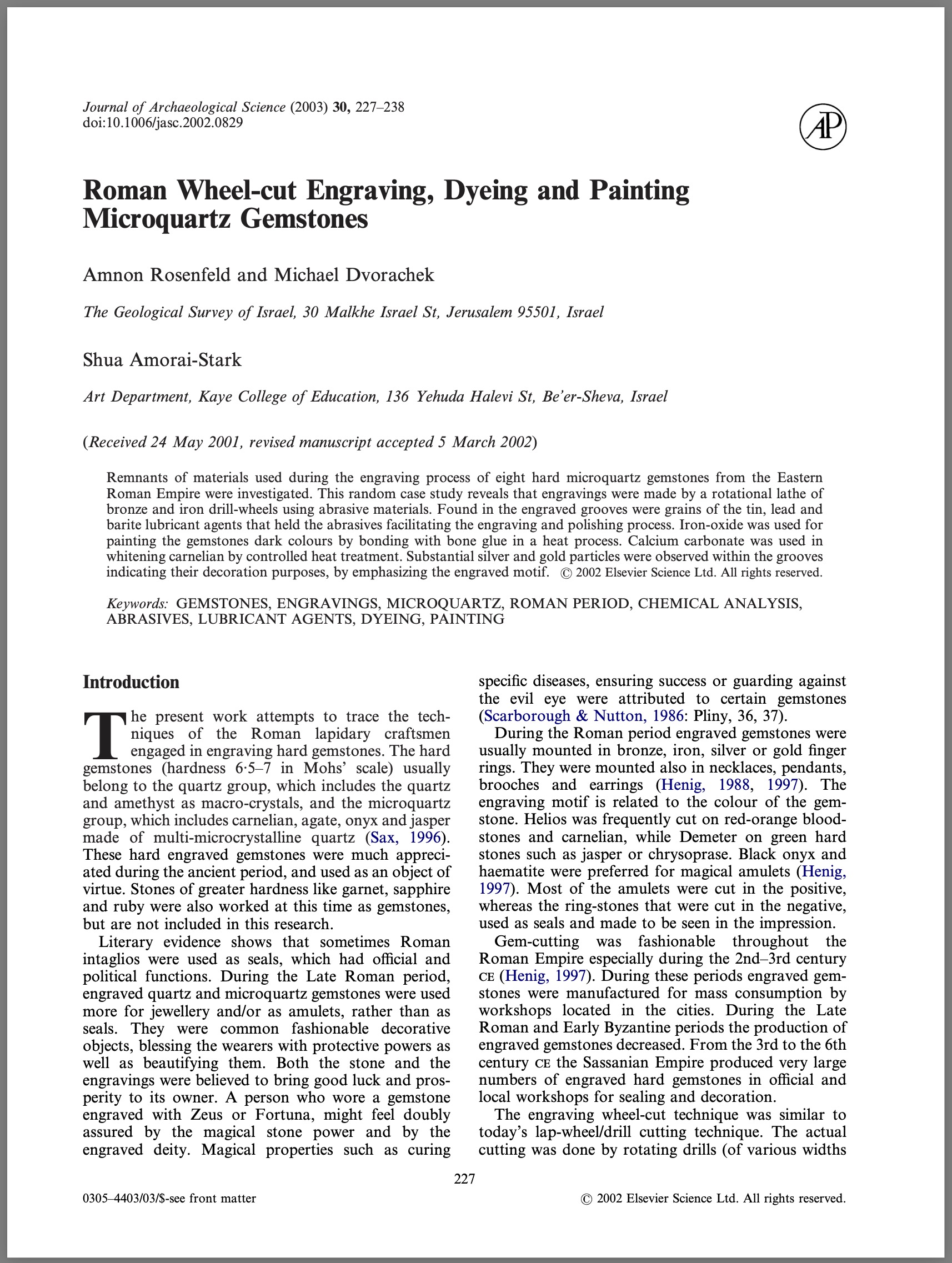
Remnants of materials used during the engraving process of eight hard microquartz gemstones from the Eastern Roman Empire were investigated. This random case study reveals that engravings were made by a rotational lathe of bronze and iron drill-wheels using abrasive materials. Found in the engraved grooves were grains of the tin, lead and barite lubricant agents that held the abrasives facilitating the engraving and poli`shing process. Iron-oxide was used for painting the gemstones dark colours by bonding with bone glue in a heat process. Calcium carbonate was used in whitening carnelian by controlled heat treatment. Substantial silver and gold particles were observed within the grooves indicating their decoration purposes, by emphasizing the engraved motif.