
Four Treasures Reference Database
Record No. 27526
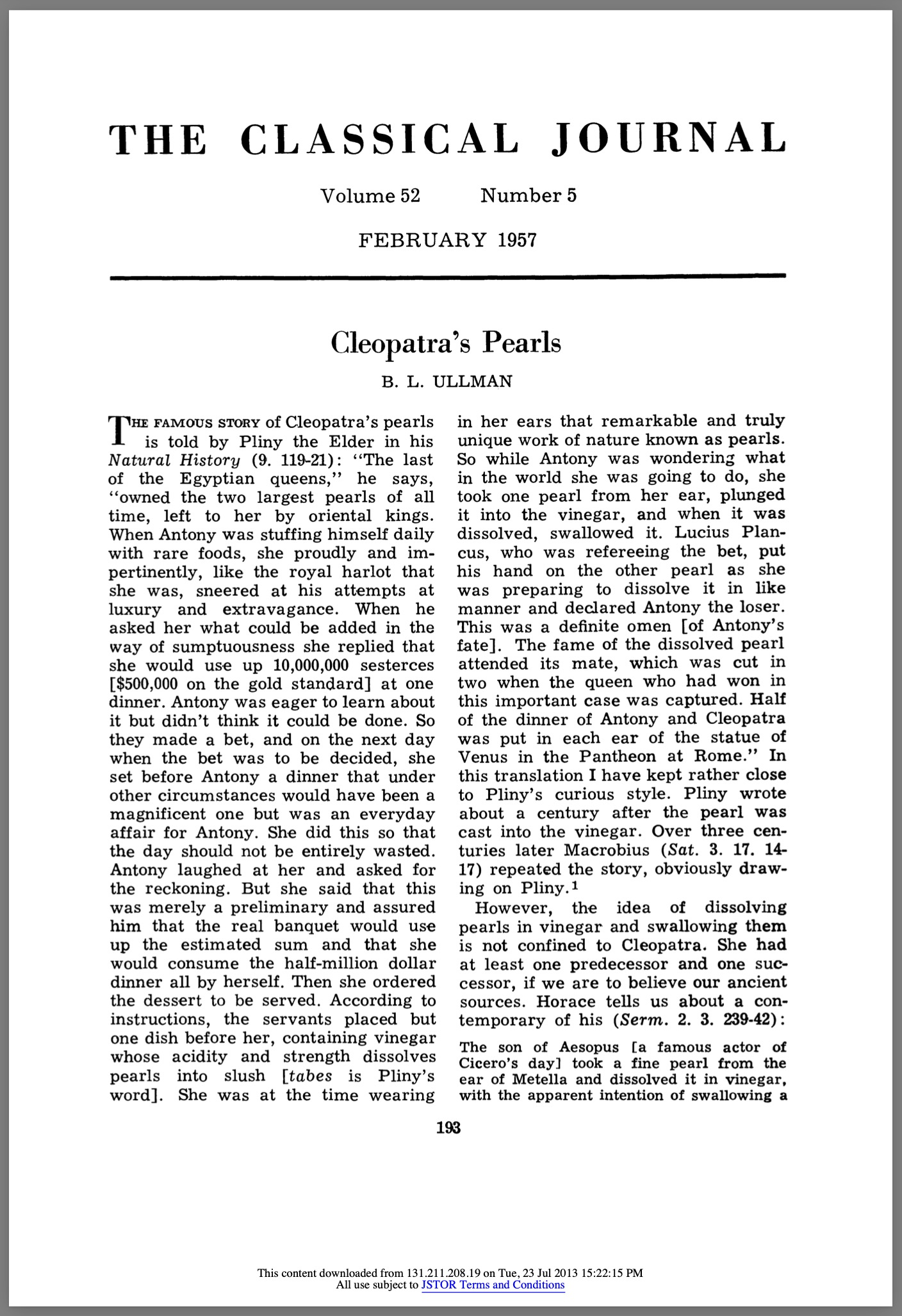
Cleopatra’s pearls
Journal Article
Ullman, B.L. (1957) Cleopatra’s pearls. The Classical Journal, Vol. 52, No. 5, February, pp. 193–201.
ISBN/ISSN: 98353 | Sinkankas/Born No.: NIS/NIB | RWHL*
gems, pearls, Pliny, Cleopatra, Marc Anthony
The famous story of Cleopatra’s pearls is told by Pliny the Elder in his Natural History (9.119–21): “The last of the Egyptian queens,” he says, “owned the two largest pearls of all time, left to her by oriental kings. When Antony was stuffing himself daily with rare foods, she proudly and impertinently, like the royal harlot that she was, sneered at his attempts at luxury and extravagance. When he asked her what could be added in the way of sumptuousness she replied that she would use up 10,000,000 sesterces [$500,000 on the gold standard] at one dinner. Antony was eager to learn about it but didn’t think it could be done. So they made a bet, and on the next day when the bet was to be decided, she set before Antony a dinner that under other circumstances would have been a magnificent one but was an everyday affair for Antony. She did this so that the day should not be entirely wasted. Antony laughed at her and asked for the reckoning. But she said that this was merely a preliminary and assured him that the real banquet would use up the estimated sum and that she would consume the half-million dollar dinner all by herself. Then she ordered the dessert to be served. According to instructions, the servants placed but one dish before her, containing vinegar whose acidity and strength dissolves pearls into slush [tabes is Pliny’s word]. She was at the time wearing in her ears that remarkable and truly unique work of nature known as pearls. So while Antony was wondering what in the world she was going to do, she took one pearl from her ear, plunged it into the vinegar, and when it was dissolved, swallowed it. Lucius Plancus, who was refereeing the bet, put his hand on the other pearl as she was preparing to dissolve it in like manner and declared Antony the loser. This was a definite omen [of Antony’s fate]. The fame of the dissolved pearl attended its mate, which was cut in two when the queen who had won in this important case was captured. Half of the dinner of Antony and Cleopatra was put in each ear of the statue of Venus in the Pantheon at Rome.” In this translation I have kept rather close to Pliny’s curious style. Pliny wrote about a century after the pearl was cast into the vinegar. Over three centuries later Macrobius (Sat. 3.17.14–17) repeated the story, obviously drawing on Pliny.