
Four Treasures Reference Database
Record No. 27539
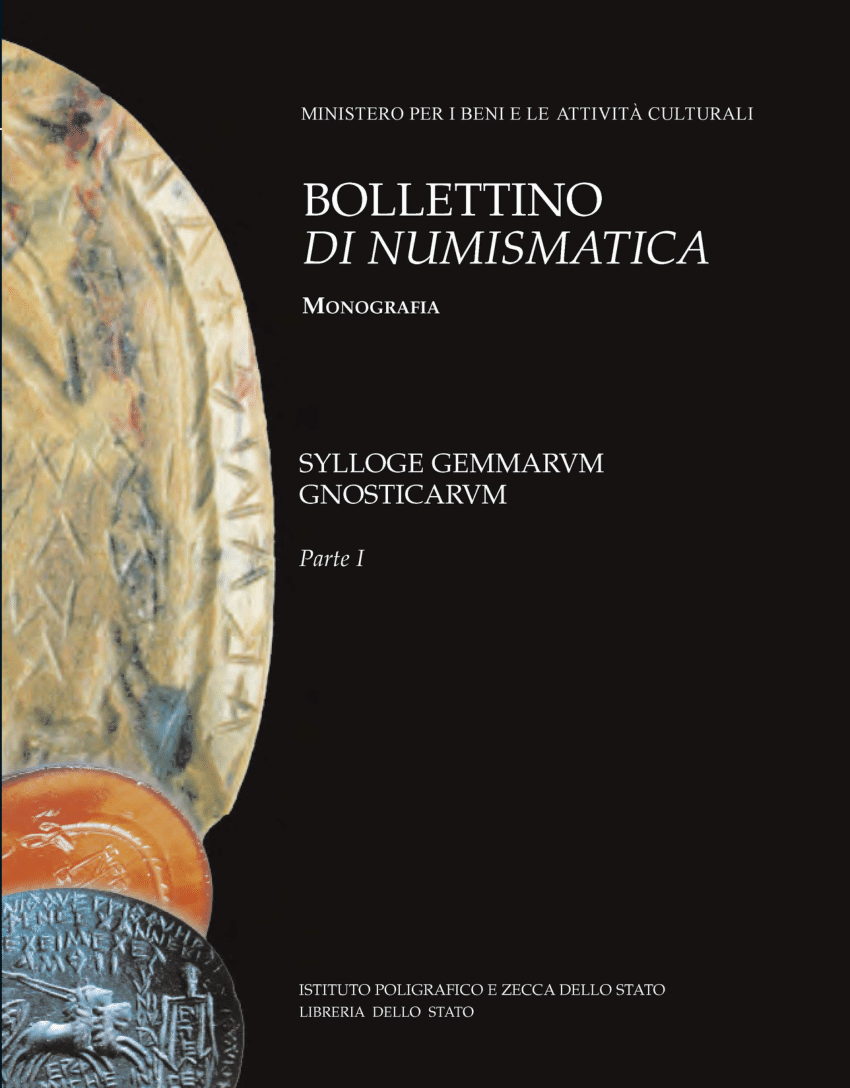
Le gemme Gnositiche
The Gnostic gems
Book Section
Mastrocinque, A. (2003) Le gemme Gnositiche. [The Gnostic gems] In: Sylloge gemmarum Gnosticarum I, Rome: Istituto Poligrafico e Zecca dello Stato, pp. 49–112.
Sinkankas/Born No.: NIS/NIB | Language: in Italian | RWHL
gems, magical gems, history of gemology, ancient gems, gem lore, gems and healing, medicinal use, Greek, Roman
The Sylloge Gemmarum Gnosticarum was born out of a need felt by many scholars of Hellenistic-Roman culture, a need expressed by A. D. Nock and A. A. Barb, the latter of whom explicitly hoped for the creation of a Corpus Gemmarum Gnosticarum. In the spirit of these two great scholars, the authors of the SGG also aim to contribute to the study of ancient civilizations, with particular attention to religion and social phenomena. Gnostic or magical gems, just like magical papyri, are the result of the modern grouping of a “class of materials” united by a common form of religious attitude, even though they originate from different religious and doctrinal currents. Clearly, the boundary between magical and non-magical gems is somewhat arbitrary, just as the boundary between magic and “normal” religiosity is vague and subjective; the controversies that arose during the trial for magic against Apuleius demonstrate how uncertain and debatable that boundary already was in antiquity. For example, one might ask to what extent (that is, in which period, at what social level, and among which religious groups) gems with astrological signs and figures referring to a person’s horoscope, or those meant for protection from illness, were considered “magical.” Therefore, we might say that the SGG will publish magical gems and those of historical-religious interest, leaving some margin of discretion in selection, as most of our predecessors have done. The prevailing modern criteria for selecting gnostic gems will be followed, such as the presence of magical inscriptions or exotic iconographies of gods, foreign to the official and public tradition. However, we will try not to engage in the modern controversy between scholars who deny the legitimacy of using the concept of “magic” and those who defend it; it will suffice to refer to the existence of Roman laws against magic, which had fairly defined targets. The Church Fathers also had something quite specific in mind when they condemned the use of phylakteria or periammata, terms that referred to all amulets, including gnostic gems.