
Four Treasures Reference Database
Record No. 27543
Fluid inclusions in fluorite mineralizations of N-W Sicily
Journal Article
Bellanca, A., De Vito, B., Lattanzi, P., Maiorani, A. and Neri, R. (1985) Fluid inclusions in fluorite mineralizations of N-W Sicily. Chemical Geology, Vol. 32, Nos. 1–4, pp. 209–216.
gems, fluorite, inclusions in fluorite, fluid inclusions
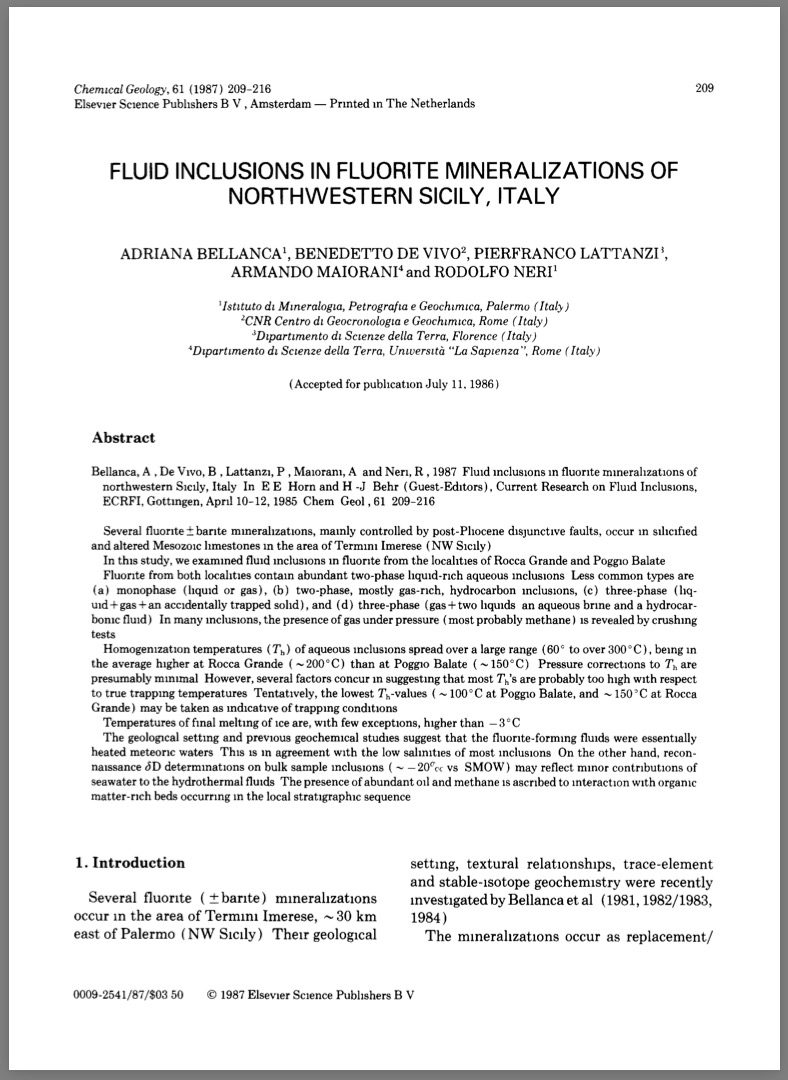
Several fluorite ± barite mineralizations, mainly controlled by post-Pliocene disjunctive faults, occur in silicified and altered Mesozoic limestones in the area of Termini Imerese (NW Sicily). In this study, we examined fluid inclusions in fluorite from the localities of Rocca Grande and Poggio Balate. Fluorite from both localities contains abundant two-phase liquid-rich aqueous inclusions. Less common types are: (a) monophase (liquid or gas); (b) two-phase, mostly gas-rich, hydrocarbon inclusions; (c) three-phase (liquid + gas + an accidentally trapped solid); and (d) three-phase (gas + two liquids: an aqueous brine and a hydrocarbonic fluid). In many inclusions, the presence of gas under pressure (most probably methane) is revealed by crushing tests. Homogenization temperatures (Th) of aqueous inclusions spread over a large range (60° to over 300 °C), being on average higher at Rocca Grande (∼200 °C) than at Poggio Balate (∼150 °C). Pressure corrections to Th are presumably minimal. However, several factors concur in suggesting that most Th’s are probably too high with respect to true trapping temperatures. Tentatively, the lowest Th-values (∼100 °C at Poggio Balate, and ∼150 °C at Rocca Grande) may be taken as indicative of trapping conditions. Temperatures of final melting of ice are, with few exceptions, higher than −3 °C. The geological setting and previous geochemical studies suggest that the fluorite-forming fluids were essentially heated meteoric waters. This is in agreement with the low salinities of most inclusions. On the other hand, reconnaissance δD determinations on bulk sample inclusions (‰ vs. SMOW) may reflect minor contributions of seawater to the hydrothermal fluids. The presence of abundant oil and methane is ascribed to interaction with organic matter-rich beds occurring in the local stratigraphic sequence.