
Four Treasures Reference Database
Record No. 27602
Adolf Furtwängler's Die antiken Gemmen (1900) and the uneasy revival of gem studies
Book Section
Hansson, U.R. (2021) Adolf Furtwängler's Die antiken Gemmen (1900) and the uneasy revival of gem studies. In: Classical Archaeology in the Late Nineteenth Century, The Formative Period 1870–1914
not seen
Close Abstract
Hide Keywords
Copy Reference
gems, glyptic, engraved gems, agate, cameo, intaglio
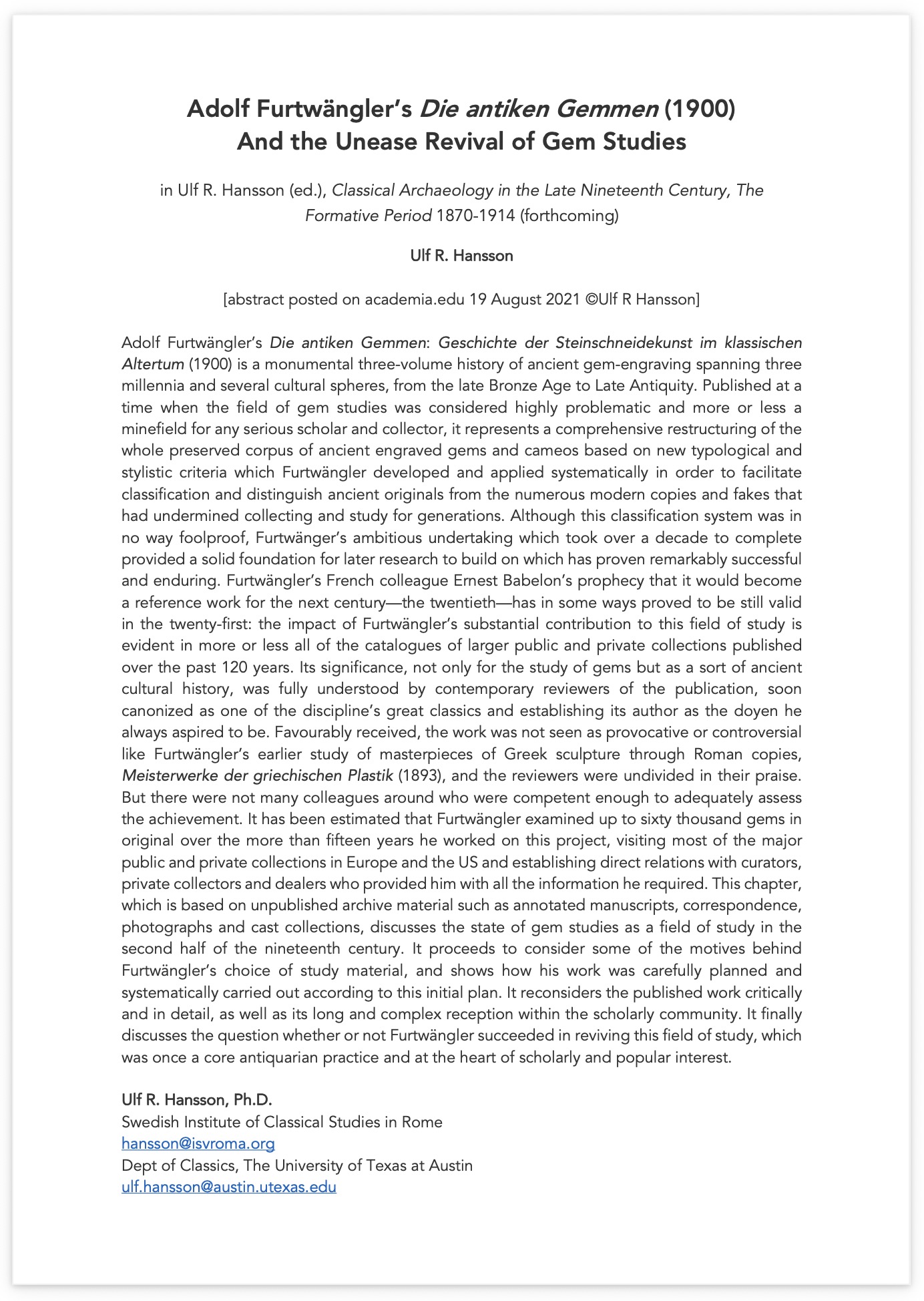
Adolf Furtwängler’s Die antiken Gemmen: Geschichte der Steinschneidekunst im klassischen Altertum (1900) is a monumental three-volume history of ancient gem-engraving spanning three millennia and several cultural spheres, from the late Bronze Age to Late Antiquity. Published at a time when the field of gem studies was considered highly problematic and more or less a minefield for any serious scholar and collector, it represents a comprehensive restructuring of the whole preserved corpus of ancient engraved gems and cameos based on new typological and stylistic criteria which Furtwängler developed and applied systematically in order to facilitate classification and distinguish ancient originals from the numerous modern copies and fakes that had undermined collecting and study for generations. Although this classification system was in no way foolproof, Furtwängler’s ambitious undertaking which took over a decade to complete provided a solid foundation for later research to build on which has proven remarkably successful and enduring. Furtwängler’s French colleague Ernest Babelon’s prophecy that it would become a reference work for the next century—the twentieth—has in some ways proved to be still valid in the twenty-first: the impact of Furtwängler’s substantial contribution to this field of study is evident in more or less all of the catalogues of larger public and private collections published over the past 120 years. Its significance, not only for the study of gems but as a sort of ancient cultural history, was fully understood by contemporary reviewers of the publication, soon canonized as one of the discipline’s great classics and establishing its author as the doyen he always aspired to be. Favourably received, the work was not seen as provocative or controversial like Furtwängler’s earlier study of masterpieces of Greek sculpture through Roman copies, Meisterwerke der griechischen Plastik (1893), and the reviewers were undivided in their praise. But there were not many colleagues around who were competent enough to adequately assess the achievement. It has been estimated that Furtwängler examined up to sixty thousand gems in original over the more than fifteen years he worked on this project, visiting most of the major public and private collections in Europe and the US and establishing direct relations with curators, private collectors and dealers who provided him with all the information he required. This chapter, which is based on unpublished archive material such as annotated manuscripts, correspondence, photographs and cast collections, discusses the state of gem studies as a field of study in the second half of the nineteenth century. It proceeds to consider some of the motives behind Furtwängler’s choice of study material, and shows how his work was carefully planned and systematically carried out according to this initial plan. It reconsiders the published work critically and in detail, as well as its long and complex reception within the scholarly community. It finally discusses the question whether or not Furtwängler succeeded in reviving this field of study, which was once a core antiquarian practice and at the heart of scholarly and popular interest.