
Four Treasures Reference Database
Record No. 27649
Material culture and philology: Semantics of mining in ancient India
Journal Article
Olivelle, P. (2012) Material culture and philology: Semantics of mining in ancient India. Journal of the American Oriental Society, Vol. 132, No. 1, January–March,
gems, ancient lapidaries, Indian lapidaries, ancient gemology, Kautilya, Sanskri, philology, word origins
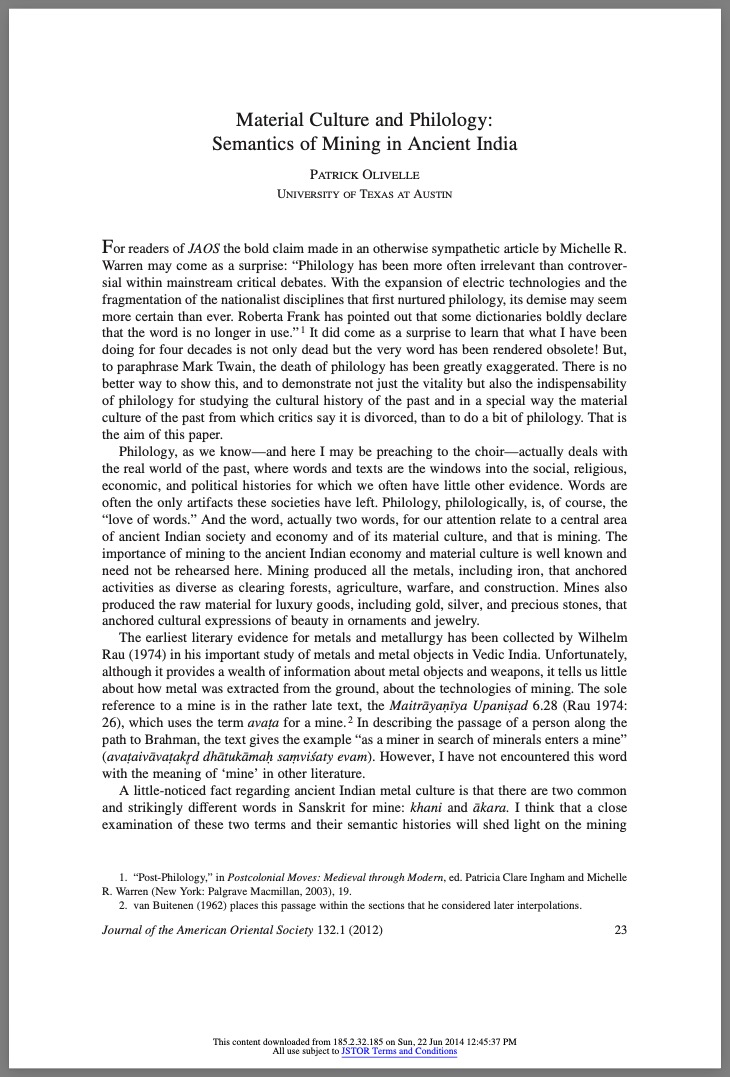
For readers of JAOS the bold claim made in an otherwise sympathetic article by Michelle R. Warren may come as a surprise: “Philology has been more often irrelevant than controversial within mainstream critical debates. With the expansion of electric technologies and the fragmentation of the nationalist disciplines that first nurtured philology, its demise may seem more certain than ever. Roberta Frank has pointed out that some dictionaries boldly declare that the word is no longer in use.” It did come as a surprise to learn that what I have been doing for four decades is not only dead but the very word has been rendered obsolete! But, to paraphrase Mark Twain, the death of philology has been greatly exaggerated. There is no better way to show this, and to demonstrate not just the vitality but also the indispensability of philology for studying the cultural history of the past and in a special way the material culture of the past from which critics say it is divorced, than to do a bit of philology. That is the aim of this paper. Philology, as we know—and here I may be preaching to the choir—actually deals with the real world of the past, where words and texts are the windows into the social, religious, economic, and political histories for which we often have little other evidence. Words are often the only artifacts these societies have left. Philology, philologically, is, of course, the “love of words.” And the word, actually two words, for our attention relate to a central area of ancient Indian society and economy and of its material culture, and that is mining. The importance of mining to the ancient Indian economy and material culture is well known and need not be rehearsed here. Mining produced all the metals, including iron, that anchored activities as diverse as clearing forests, agriculture, warfare, and construction. Mines also produced the raw material for luxury goods, including gold, silver, and precious stones, that anchored cultural expressions of beauty in ornaments and jewelry.