
Four Treasures Reference Database
Record No. 27651
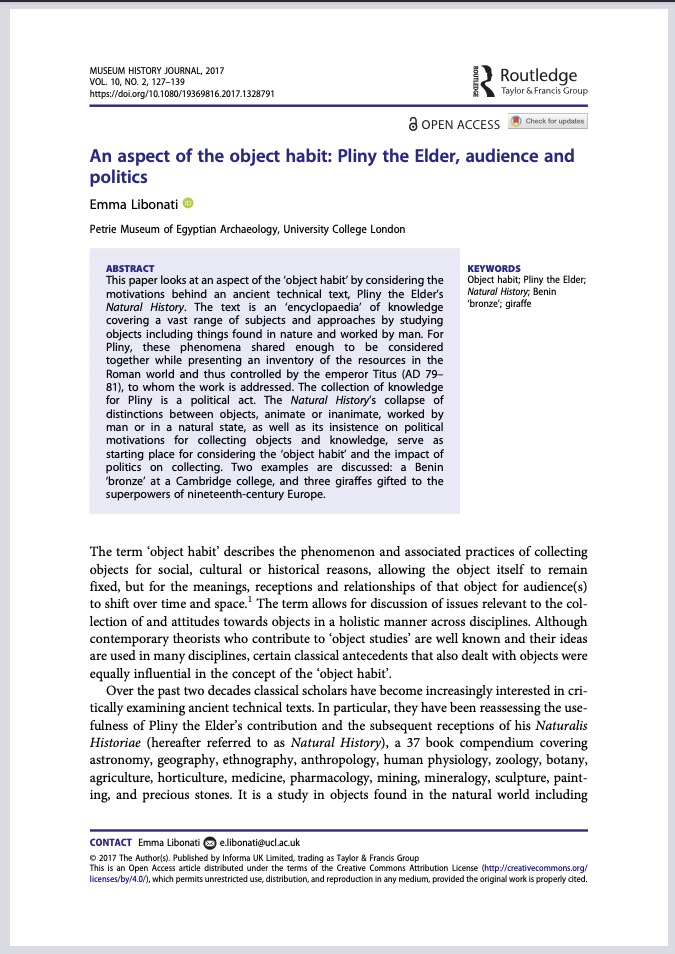
An aspect of the object habit: Pliny the Elder, audience and politics
Journal Article
Libonati, E. (2017) An aspect of the object habit: Pliny the Elder, audience and politics. Museum History Journal, Vol. 10, No. 2, pp. 127–139.
gems, ancient gemology, ancient jewelry, Pliny, ancient texts
This paper looks at an aspect of the ‘object habit’ by considering the motivations behind an ancient technical text, Pliny the Elder’s Natural History. The text is an ‘encyclopaedia’ of knowledge covering a vast range of subjects and approaches by studying objects including things found in nature and worked by man. For Pliny, these phenomena shared enough to be considered together while presenting an inventory of the resources in the Roman world and thus controlled by the emperor Titus (AD 79–81), to whom the work is addressed. The collection of knowledge for Pliny is a political act. The Natural History’s collapse of distinctions between objects, animate or inanimate, worked by man or in a natural state, as well as its insistence on political motivations for collecting objects and knowledge, serve as starting place for considering the ‘object habit’ and the impact of politics on collecting. Two examples are discussed: a Benin ‘bronze’ at a Cambridge college, and three giraffes gifted to the superpowers of nineteenth-century Europe.