
Four Treasures Reference Database
Record No. 27675
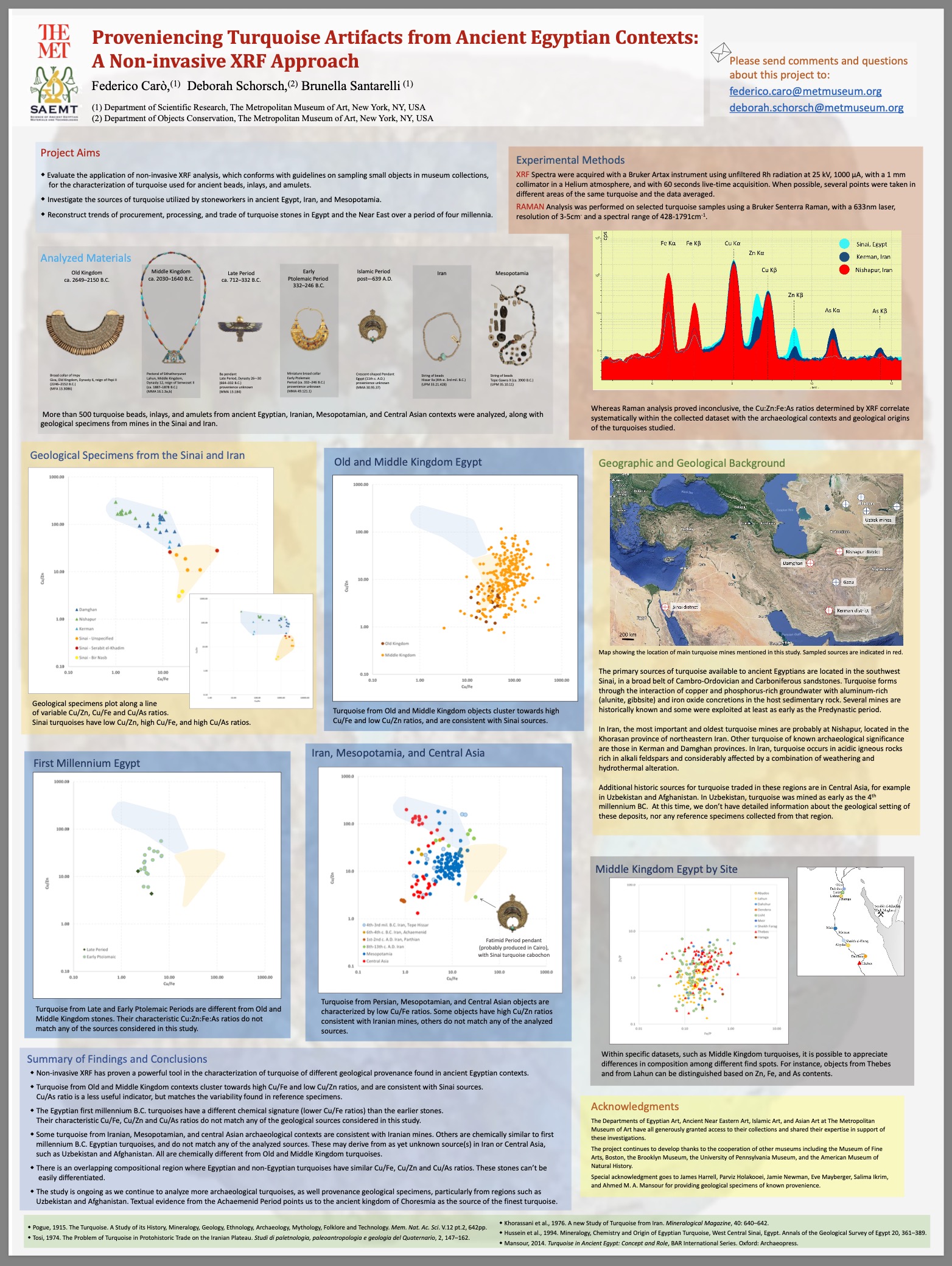
Proveniencing turquoise artifacts from ancient Egyptian contexts: A non-invasive XRF approach
Conference Paper
Carò, F., Schorsch, D. and Santarelli, B. (2017) Proveniencing turquoise artifacts from ancient Egyptian contexts: A non-invasive XRF approach. Science of Ancient Egyptian Materials and Technologies (SAEMT) Conference, 4–6 November, Cairo poster presentation.
Sinkankas/Born No.: NIS/NIB | RWHL*
gems, turquoise, origin determination, provenance
Non-invasive XRF has proven a powerful tool in the characterization of turquoise of different geological provenance found in ancient Egyptian contexts. Turquoise from Old and Middle Kingdom contexts clusters towards high Cu/Fe and low Cu/Zn ratios and is consistent with Sinai sources; the Cu/As ratio is a less useful indicator but matches the variability found in reference specimens. In contrast, first millennium B.C. Egyptian turquoises show a different chemical signature with lower Cu/Fe ratios, and their characteristic Cu/Fe, Cu/Zn, and Cu/As ratios do not match any of the geological sources considered in the study. Some turquoise from Iranian, Mesopotamian, and Central Asian archaeological contexts aligns with Iranian mines, while others resemble first millennium B.C. Egyptian turquoises and do not match any known analyzed sources—these may originate from unidentified sources in Iran or Central Asia, such as Uzbekistan and Afghanistan, and are chemically distinct from Old and Middle Kingdom turquoises. There is also an overlapping compositional region where Egyptian and non-Egyptian turquoises share similar Cu/Fe, Cu/Zn, and Cu/As ratios, making differentiation difficult. The study is ongoing, with further analysis of archaeological turquoise and geological specimens, especially from Uzbekistan and Afghanistan; textual evidence from the Achaemenid period suggests that the ancient kingdom of Choresmia was the source of the finest turquoise.