
Four Treasures Reference Database
Record No. 27693
Shahr-i Sokhta and Tepe Yahya: Tracks on the earliest history of the Iranian Plateau
Journal Article
Lamberg-Karlovsky, C.C. and Tosi, M. (1973) Shahr-i Sokhta and Tepe Yahya: Tracks on the earliest history of the Iranian Plateau. East and West, Vol. 23, No. 1/2, March–April, pp. 21–57.
Sinkankas/Born No.: NIS/NIB | RWHL
gems, ancient history, Persia, Iran, Mesopotamia, Persian Gulf, Turkmenistan
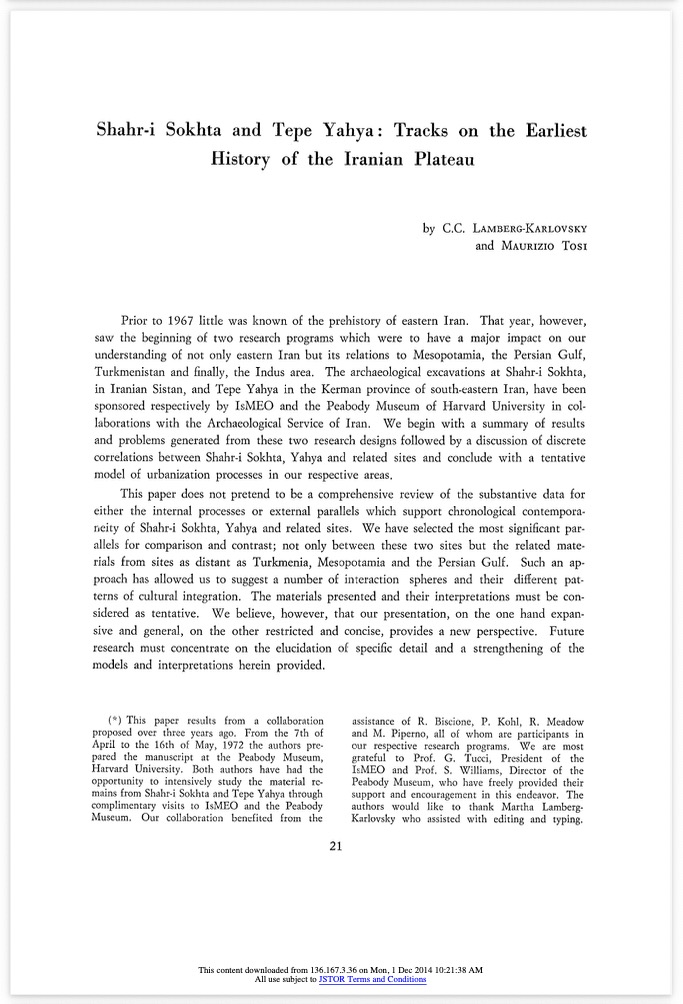
Prior to 1967, little was known of the prehistory of eastern Iran. That year, however, saw the beginning of two research programs which were to have a major impact on our understanding not only of eastern Iran but also of its relations with Mesopotamia, the Persian Gulf, Turkmenistan, and, ultimately, the Indus area. The archaeological excavations at Shahr-i Sokhta in Iranian Sistan and Tepe Yahya in the Kerman province of southeastern Iran have been sponsored respectively by IsMEO and the Peabody Museum of Harvard University in collaboration with the Archaeological Service of Iran. We begin with a summary of results and problems generated from these two research designs, followed by a discussion of discrete correlations between Shahr-i Sokhta, Yahya, and related sites, and conclude with a tentative model of urbanization processes in our respective areas. This paper does not pretend to be a comprehensive review of the substantive data for either the internal processes or external parallels which support the chronological contemporaneity of Shahr-i Sokhta, Yahya, and related sites. We have selected the most significant parallels for comparison and contrast—not only between these two sites but also the related materials from sites as distant as Turkmenia, Mesopotamia, and the Persian Gulf. Such an approach has allowed us to suggest a number of interaction spheres and their different patterns of cultural integration. The materials presented and their interpretations must be considered as tentative. We believe, however, that our presentation, on the one hand expansive and general, on the other restricted and concise, provides a new perspective. Future research must concentrate on the elucidation of specific detail and a strengthening of the models and interpretations herein provided.