
Four Treasures Reference Database
Record No. 27695
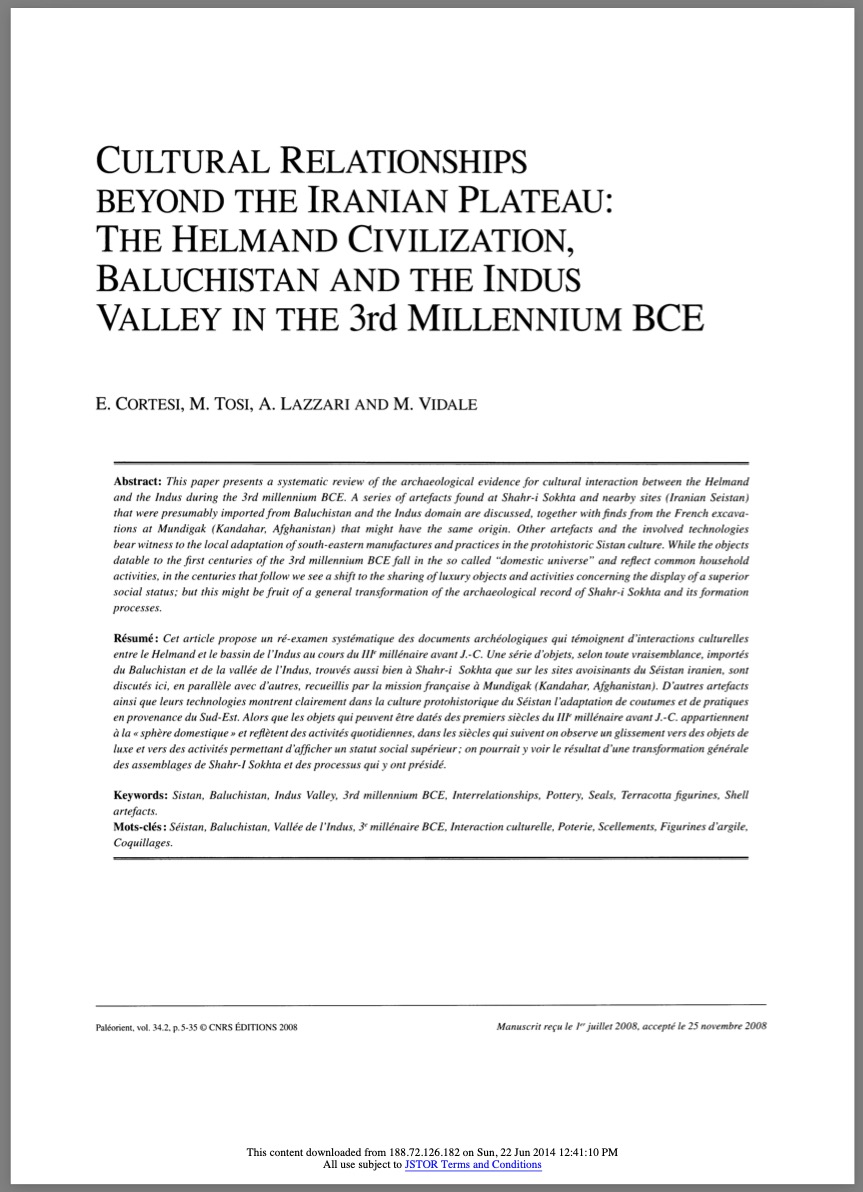
Cultural Relationships beyond the Iranian Plateau: The Helmand Civilization, Baluchistan and the Indus Valley in the 3rd Millennium BCE
Journal Article
Cortesi, E., Tosi, M., Lazzari, A. and Vidale, M. (2008) Cultural Relationships beyond the Iranian Plateau: The Helmand Civilization, Baluchistan and the Indus Valley in the 3rd Millennium BCE. Paléorient, Vol. 34, No. 2, pp. 5–35.
Sinkankas/Born No.: NIS/NIB | RWHL
gems, ancient history, Central Asia, Scythia, Korea, China, Baikal, Siberia, Russia, Mongolia, Greece, India, Pakistan
This paper presents a systematic review of the archaeological evidence for cultural interaction between the Helmand and the Indus during the 3rd millennium BCE. A series of artefacts found at Shahr-i Sokhta and nearby sites (Iranian Seistan) that were presumably imported from Baluchistan and the Indus domain are discussed, together with finds from the French excavations at Mundigak (Kandahar, Afghanistan) that might have the same origin. Other artefacts and the technologies involved bear witness to the local adaptation of southeastern manufactures and practices in the protohistoric Sistan culture. While the objects datable to the first centuries of the 3rd millennium BCE fall in the so-called “domestic universe” and reflect common household activities, in the centuries that follow we see a shift to the sharing of luxury objects and activities concerning the display of superior social status; but this might be the result of a general transformation of the archaeological record of Shahr-i Sokhta and its formation processes.