
Four Treasures Reference Database
Record No. 27701
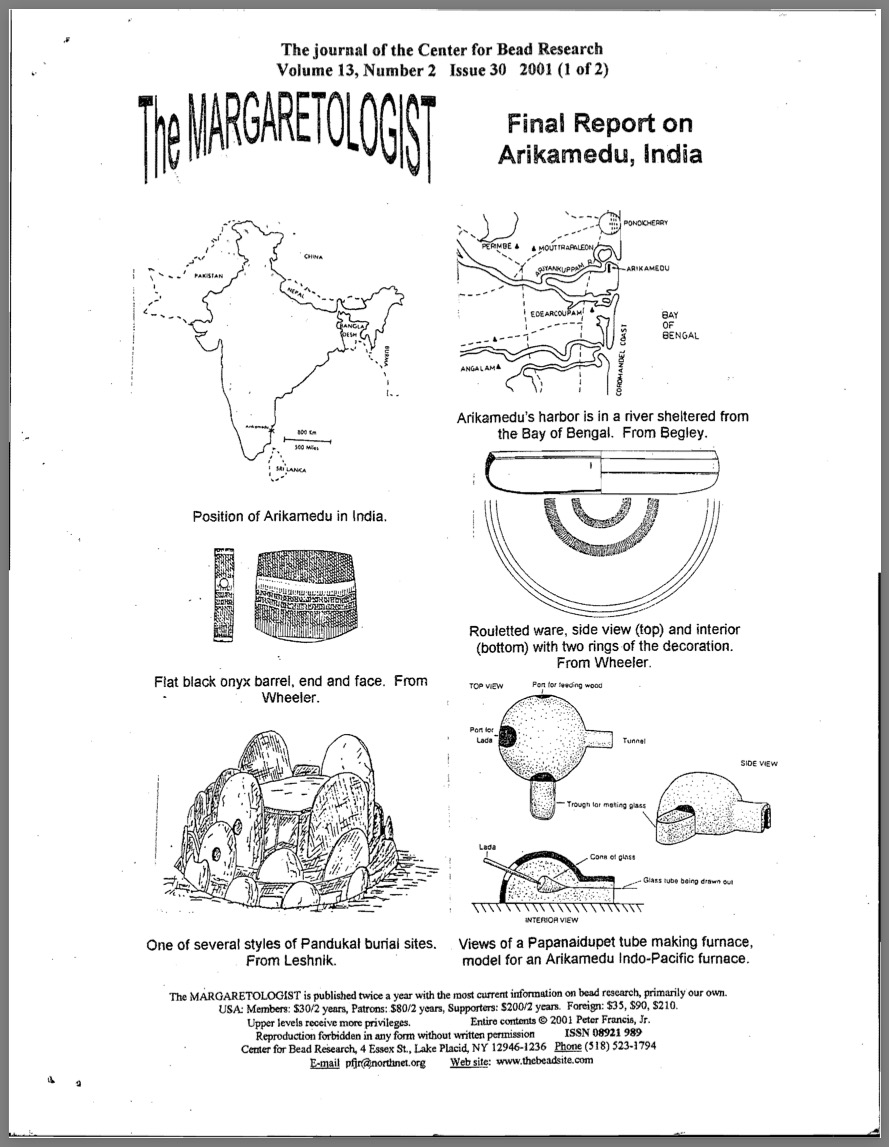
Final report on Arikamedu
Journal Article
Francis, P. (2001) Final report on Arikamedu. The Margetologist, Vol. 13, No. 2, Issue 30, pp. 3–12.
Sinkankas/Born No.: NIS/NIB | RWHL
gems, beads, agate, carnelian, lapidary arts, cutting, Arikamedu, Pondicherry, India, stone, glass
In 1734 the Consul of the Indo-French enclave of Pondicherry sent a note to the French East India Company observing that the villagers of Virampatnam (variously spelled) were taking bricks from an old place near their village. Later in the century Le Gentil, on a trip around the world to observe astronomical phenomena for the King of France, reported the same thing and said the villagers told him that the large bricks came from what they described as the castle of King Vira-Raguen: “A true Roman city.” The site was reported upon occasionally thereafter, but it was nearly two centuries before G. Jouveau-Dubreuil, a French historian, visited it and saw beads and wasters on the ground. Children from Virampatnam followed him around offering things they had picked up after the rains for a few centimes. One item was a seal engraved with what he believed to be the head of the young Caesar Augustus. He wrote a letter to the Governor of French India declaring that here was “a true Roman city.”