
Four Treasures Reference Database
Record No. 27720
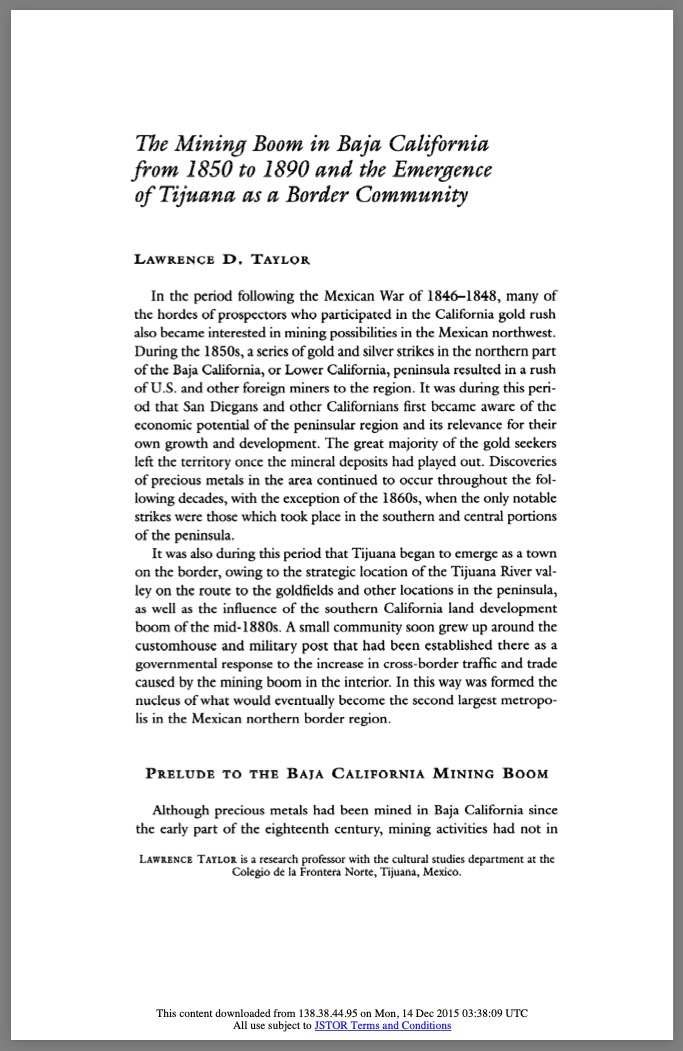
The mining boom in Baja California from 1850 to 1890 and the emergence of Tijuana as a border community
Journal Article
Taylor, L.D. (2001) The mining boom in Baja California from 1850 to 1890 and the emergence of Tijuana as a border community. Journal of the Southwest, Vol. 43, No. 4, pp. 463–492.
ISBN/ISSN: 8948410 | Sinkankas/Born No.: NIS/NIB | RWHL
gems, USA, Baja California, mining, San Diego County
In the period following the Mexican War of 1846–1848, many of the prospectors who had joined the California gold rush turned their attention to mining opportunities in the Mexican northwest. During the 1850s, a series of gold and silver strikes in northern Baja California drew U.S. and other foreign miners to the region, marking the first time San Diegans and other Californians recognized the economic potential of the peninsula and its relevance to their own development. While most gold seekers left once deposits were exhausted, discoveries continued in subsequent decades, except during the 1860s when notable strikes occurred mainly in the central and southern peninsula. This era also saw the rise of Tijuana as a border town, due to its strategic position in the Tijuana River valley on the route to the goldfields and its connection to the southern California land boom of the mid-1880s. A small community formed around the local customhouse and military post, established to manage increasing cross-border trade and traffic from the mining boom—laying the foundation for what would become the second largest metropolis on Mexico’s northern border.