
Four Treasures Reference Database
Record No. 27752
The glory of turquoise from Neolithic to Bronze Age in Persia
Conference Paper
Shirdam, B., Yang, M. and Shen, A.H. (2020) The glory of turquoise from Neolithic to Bronze Age in Persia. Wuhan International Gems and Jeweleries Symposium, Wuhan, China 4 pp..
Sinkankas/Born No.: NIS/NIB | RWHL*
gems, turquoise, coral, Tibet, Nepal, gold, lapis lazuli
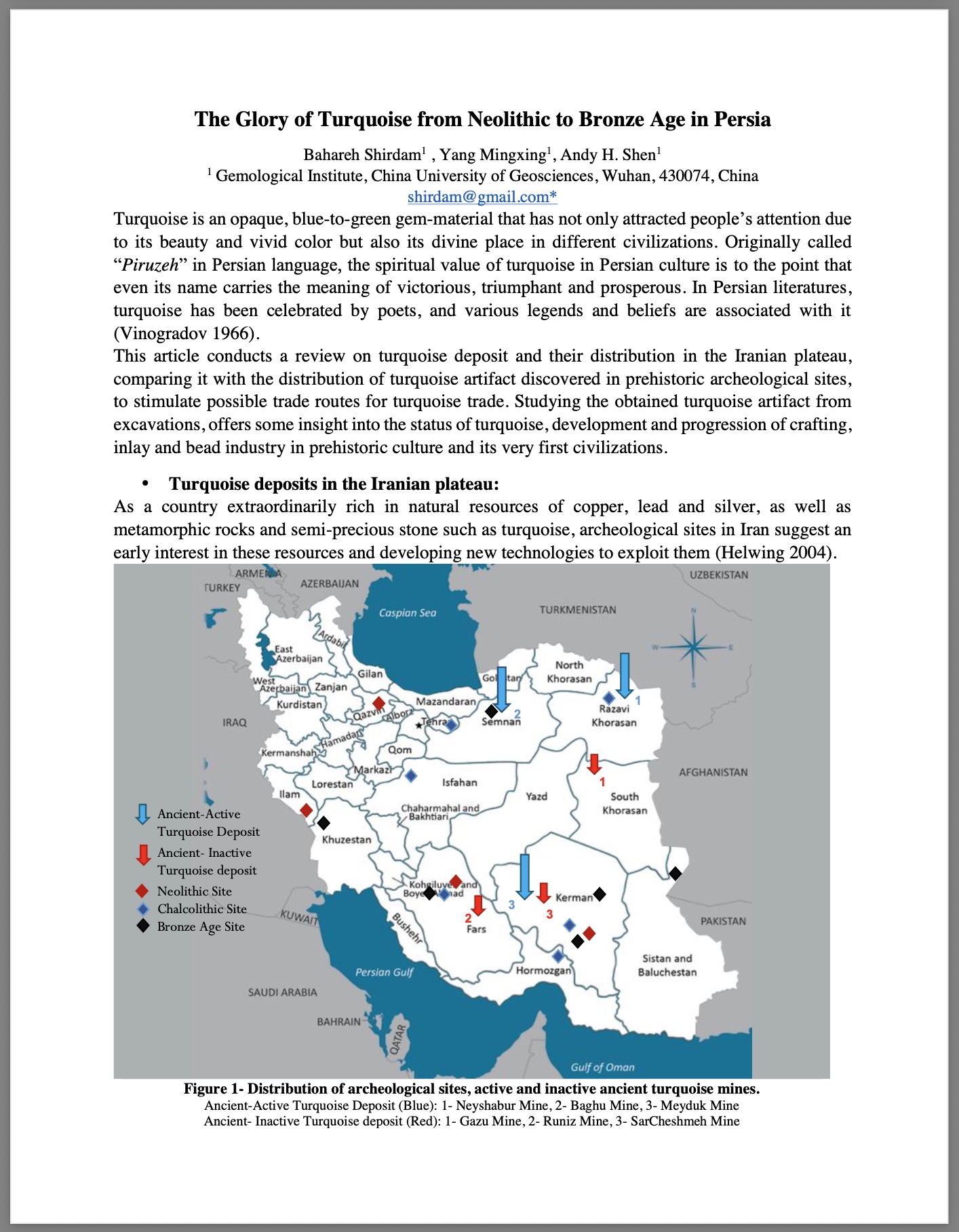
Turquoise is an opaque, blue-to-green gem material that has attracted people’s attention not only for its beauty and vivid color but also for its divine place in various civilizations. Originally called “Piruzeh” in Persian, the spiritual value of turquoise in Persian culture is so significant that even its name conveys meanings of victory, triumph, and prosperity. In Persian literature, turquoise has been celebrated by poets, and various legends and beliefs are associated with it (Vinogradov, 1966). This article reviews turquoise deposits and their distribution on the Iranian plateau, comparing them with the distribution of turquoise artifacts discovered in prehistoric archaeological sites, to propose possible trade routes for turquoise exchange. Studying turquoise artifacts recovered from excavations provides insights into the status of turquoise, as well as the development and progression of crafting, inlay, and bead industries in prehistoric cultures and early civilizations. Turquoise in Iran has been traced back as far as 7500 B.C.