
Four Treasures Reference Database
Record No. 27793
Museum Review: Recovered treasures form Afghanistan
Journal Article
Ogden, J. (2007) Museum Review: Recovered treasures form Afghanistan. American Journal of Archaeology, Vol. 111, No. 3, pp. 559–563.
ISBN/ISSN: 00029114, 1939828X | Sinkankas/Born No.: NIS/NIB | RWHL*
gems, Afghanistan, Panjshir Valley, beryl, emerald
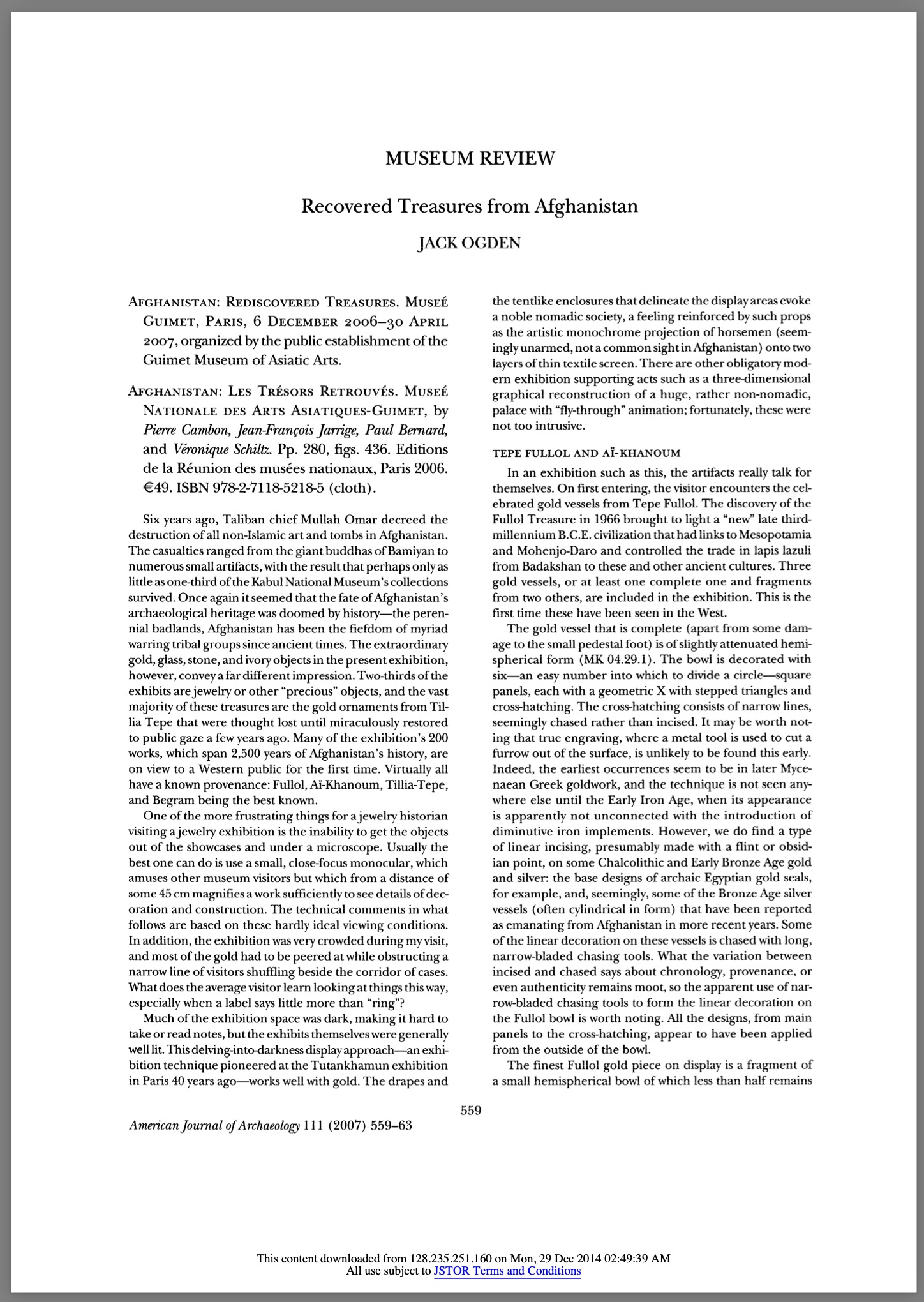
Six years ago, Taliban chief Mullah Omar ordered the destruction of all non-Islamic art and tombs in Afghanistan, a campaign that devastated the country’s cultural heritage—from the monumental Buddhas of Bamiyan to countless small artifacts—leaving perhaps only a third of the Kabul National Museum’s collection intact. It seemed once again that Afghanistan’s archaeological legacy was fated to be lost amid its long history of tribal conflict and instability. Yet the extraordinary gold, glass, stone, and ivory objects in the current exhibition tell another story. Two-thirds of the objects are jewellery or other precious items, and most are the gold ornaments from Tilia Tepe, believed lost but now astonishingly returned to public view. Many of the 200 works on display—spanning 2,500 years of Afghanistan’s history—are being shown to a Western audience for the first time. Most have secure provenance, with sites like Fullol, Ai-Khanoum, Tilia Tepe, and Begram well represented. For a jewellery historian, a common frustration in such exhibitions is the inability to examine pieces under a microscope; one must make do with a small close-focus monocular, which—despite amusing nearby visitors—allows for enough magnification at 45 cm to observe some construction and decorative details. The technical observations that follow are based on these less-than-ideal viewing conditions, compounded by the crowded exhibition space where many of the gold objects had to be viewed while obstructing a narrow, slow-moving line of visitors. One wonders what the average visitor learns in such a setting, especially when labels offer little more than the word “ring.”