
Four Treasures Reference Database
Record No. 27817
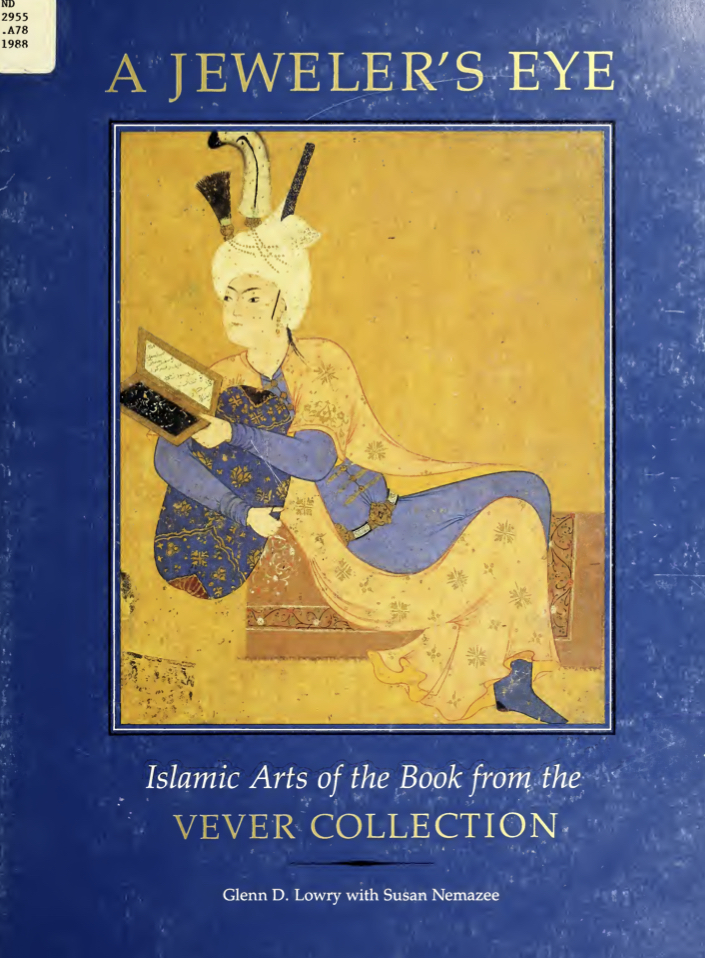
A Jeweler’s Eye | Islamic Arts of the Book from the Vever Collection
Book
Lowry, G.D. and Nemazee, S. (1988) A Jeweler’s Eye | Islamic Arts of the Book from the Vever Collection. Washington, DC, Smithsonian Institution, 240 pp.
ISBN/ISSN: 295966769 | Sinkankas/Born No.: NIS/NIB | RWHL
gems, ancient gems, Islamic art, Islamic book, caligraphy, illustrated books
The calligraphy, illustrations, and decorations that embellish the great books of expressive intimacy and technical brilliance are basic characteristics of the works. For these reasons they appealed deeply to Henri Vever, well known to the artistic world of Paris in the early twentieth century as a jeweler, collector, and painter. Vever amassed some five hundred Persian, Arabic, Turkish, and Indian manuscripts, paintings, albums, bookbindings, and examples of calligraphy, as well as small groups of lithographs, printed books, textiles, nineteenth-century Burmese and Indonesian works, and Armenian paintings. This material now comprises the Vever Collection in the Arthur M. Sackler Gallery. Vever was so perceptive and thorough a collector and connoisseur that the unexpected, intact reappearance of the collection he amassed is not only a breakthrough in the study of Persian and Indian art but also greatly expands our understanding of French taste and culture. During his lifetime Vever was eager for these works to become better known. Items from his Islamic collections were widely shown in Europe early in this century, especially at the influential exhibitions held in Paris in 1912 and London in 1931, and he generously encouraged their publication. The collection disappeared following Vever’s death in 1942, and many thought the entire group was destroyed in World War II. A chance encounter between the owner of the works and Faure Fowry—whose son, Glenn D. Fowry, is curator of Near Eastern art at the Arthur M. Sackler Gallery and Freer Gallery of Art—led to information that the collection had indeed survived. Learning the owner’s identity was extraordinary serendipity, especially for a new museum, and it set off a remarkable campaign to purchase a body of material that Secretary of the Smithsonian Institution, Robert McCormick Adams, termed “perhaps the most important acquisition in the history of the Smithsonian Institution.”