
Four Treasures Reference Database
Record No. 27819
X-ray fluorescence analysis of some Dark Age jewellery
Journal Article
Hawkes, S.C., Merrick, J.M. and Metcalf, D.M. (1966) X-ray fluorescence analysis of some Dark Age jewellery. Archaeometry, Vol. 9, pp. 98–138.
gems, ancient metal use, coinage, numismatic, gold, silver, electrum
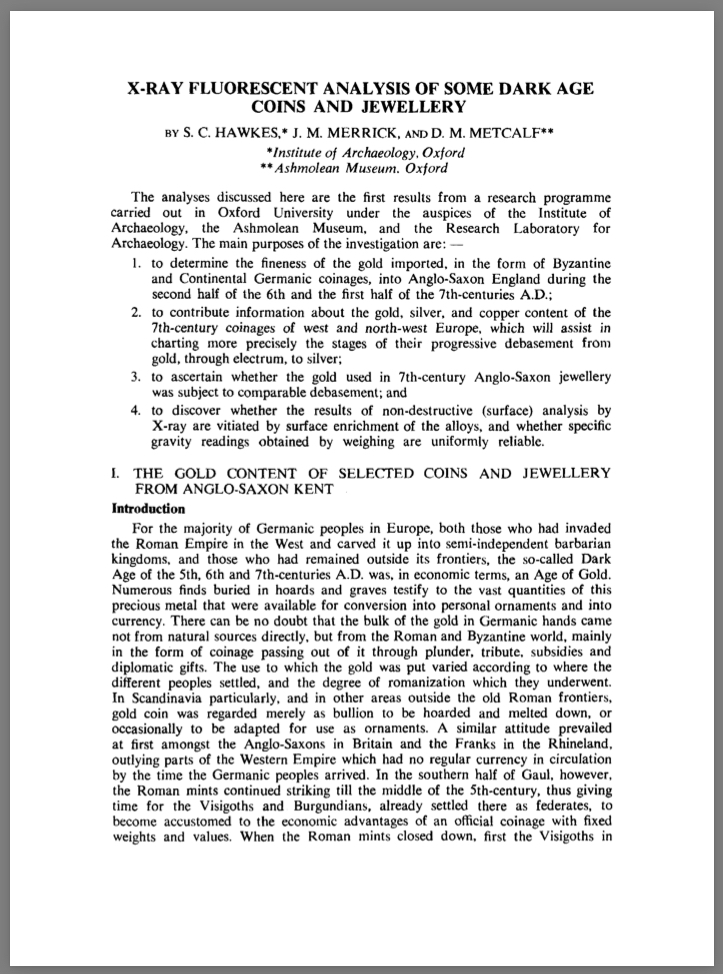
The analyses discussed here are the first results from a research programme carried out at Oxford University under the auspices of the Institute of Archaeology, the Ashmolean Museum, and the Research Laboratory for Archaeology. The main purposes of the investigation are: (1) to determine the fineness of the gold imported, in the form of Byzantine and Continental Germanic coinages, into Anglo-Saxon England during the second half of the 6th and the first half of the 7th centuries A.D.; (2) to contribute information about the gold, silver, and copper content of the 7th-century coinages of west and north-west Europe, which will assist in charting more precisely the stages of their progressive debasement from gold, through electrum, to silver; (3) to ascertain whether the gold used in 7th-century Anglo-Saxon jewellery was subject to comparable debasement; and (4) to discover whether the results of non-destructive (surface) analysis by X-ray are vitiated by surface enrichment of the alloys, and whether specific gravity readings obtained by weighing are uniformly reliable.