
Four Treasures Reference Database
Record No. 27857
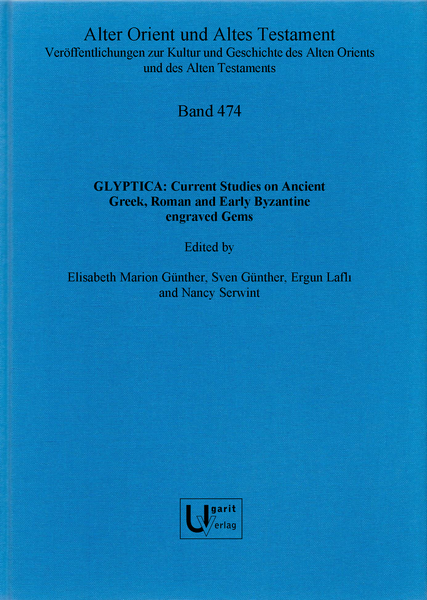
GLYPTICA: Current Studies on Ancient Greek, Roman and Early Byzantine Engraved Gems
Edited Book
Günther, E.M., Günther, S., Lafli, E. and Serwint, N., editor (2025) GLYPTICA: Current Studies on Ancient Greek, Roman and Early Byzantine Engraved Gems.. Ugarit-Verlag, Münster, Germany, 663 pp..
ISBN/ISSN: 9783870000000 | Sinkankas/Born No.: NIS/NIB | not seen
gems, glyptic, engraved gems, agate, cameo, intaglio
Martin Henig: This book is, to my knowledge, only the second conference proceedings which has been devoted in large part to gems from specific sites in the Graeco-Roman world. The first, held in Aquileia in 2008, was centred on the large quantity of intaglios manufactured in that city at the head of the Adriatic and thus at a key point to trade with the northwestern provinces and beyond and so the focus was on the western part of the Roman Empire. The only other major international conferences on gems have dealt with their afterlife in Medieval, Renaissance, and Neo-Classical Europe, in the National Gallery of Art, Washington D.C. in 1994; and on Late Roman gems, at the British Museum in 2009. In addition the Rijksmuseum van Oudheden, Leiden staged a conference on a slightly smaller scale at the culmination of their Engraved Gems project in 2016 with a group of papers on various aspects of glyptics, published in the following year. The extensive range of papers published here is in large part concerned with Fundgemmen, as was the Aquileia conference but the contributions are in many respects more comprehensive, dealing with gems from sites all around the Mediterranean and Black Sea, which were the heartland of Greek and Roman power and culture. Writing this Preface, I have to confess feeling like an interloper as so much of my own work on gems has been concerned with intaglios and cameos from the most northwesterly province of the Roman Empire, Britannia, far away from the Mediterranean, on which I wrote my doctoral dissertation which was approved in 1972 and published two years later. However, even while writing my thesis I was conscious that the iconography of the figure types with which I was dealing in studying local finds led me back through Rome to Classical Greece. Indeed, John Boardman who had just published his magnum opus on Greek gems, was happy for me to attend his Greek seminar, to which he invited me to contribute on this very theme. Some of the fruits of that encouragement to make a large part of my academic life in gems are hopefully apparent in my main paper here.