
Four Treasures Reference Database
Record No. 27873
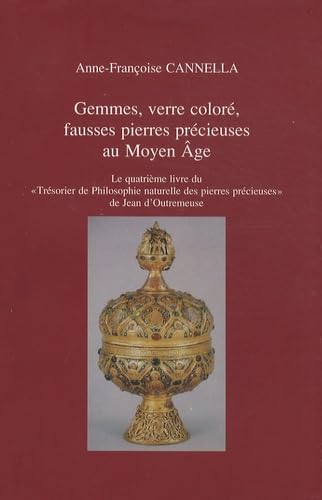
Gemmes, verre coloré, fausses pierres précieuses au Moyen Âge, le quatrième livre du Trésorier de Philosophie naturelle des pierres précieuses de Jean d’Outremeuse
Gems, Colored Glass, and Imitation Gemstones in the Middle Ages: The Fourth Book of the Treasury of Natural Philosophy of Precious Stones by Jean d’Outremeuse
Book
Cannella, A.-F. (2006) Gemmes, verre coloré, fausses pierres précieuses au Moyen Âge, le quatrième livre du Trésorier de Philosophie naturelle des pierres précieuses de Jean d’Outremeuse. [Gems, Colored Glass, and Imitation Gemstones in the Middle Ages: The Fourth Book of the Treasury of Natural Philosophy of Precious Stones by Jean d’Outremeuse] Geneva, Université de Liège – Bibliothèque de la Faculté de Philosophie et Lettres, 480 pp.
ISBN/ISSN: 9782870000000 | Sinkankas/Born No.: NIS/NIB | Language: in French | not seen
gems, ancient lapidaries, Jean d'Outremeuse, alchemy, astrology, history, 14th century
At the center of our research lies an unpublished work: the Treasury of Natural Philosophy of Precious Stones by the Liègeois chronicler Jean d’Outremeuse, and more specifically the fourth book of this treatise. Both a lapidary and a recipe book, it is devoted essentially to one of the most fascinating yet little-known forms of the art of glassmaking — the fabrication of imitation gemstones — a text that has remained unpublished despite being written by the most famous of medieval authors from Liège, and finally, shrouded in mystery regarding both its origin and the context of its composition. Jean d’Outremeuse’s Treasury of Natural Philosophy of Precious Stones thus merits in-depth study. To reconstruct an ancient technique, the researcher can draw on various sources and methods. Laboratory analyses are today considered indispensable for a thorough understanding of the works or techniques in question. The study of written technical sources, despite recent renewed interest, still lacks such recognition. Yet it proves to be highly enriching. In any case, literature and scientific analysis are two complementary approaches. The literature of recipes or secrets spans a long period, from Antiquity to the 19th century. A veritable goldmine of information for artisans, restorers, art historians, or historians of technology, it remains a potential that is still far too underexplored. Researchers generally limit themselves to referencing the most well-known treatises — especially those already published and studied. However, there exists a vast number of recipe collections, both manuscript and printed, covering the widest variety of activities, whether artistic techniques, culinary or cosmetic recipes, methods for domestic use, or medicinal remedies.