
Four Treasures Reference Database
Record No. 27882
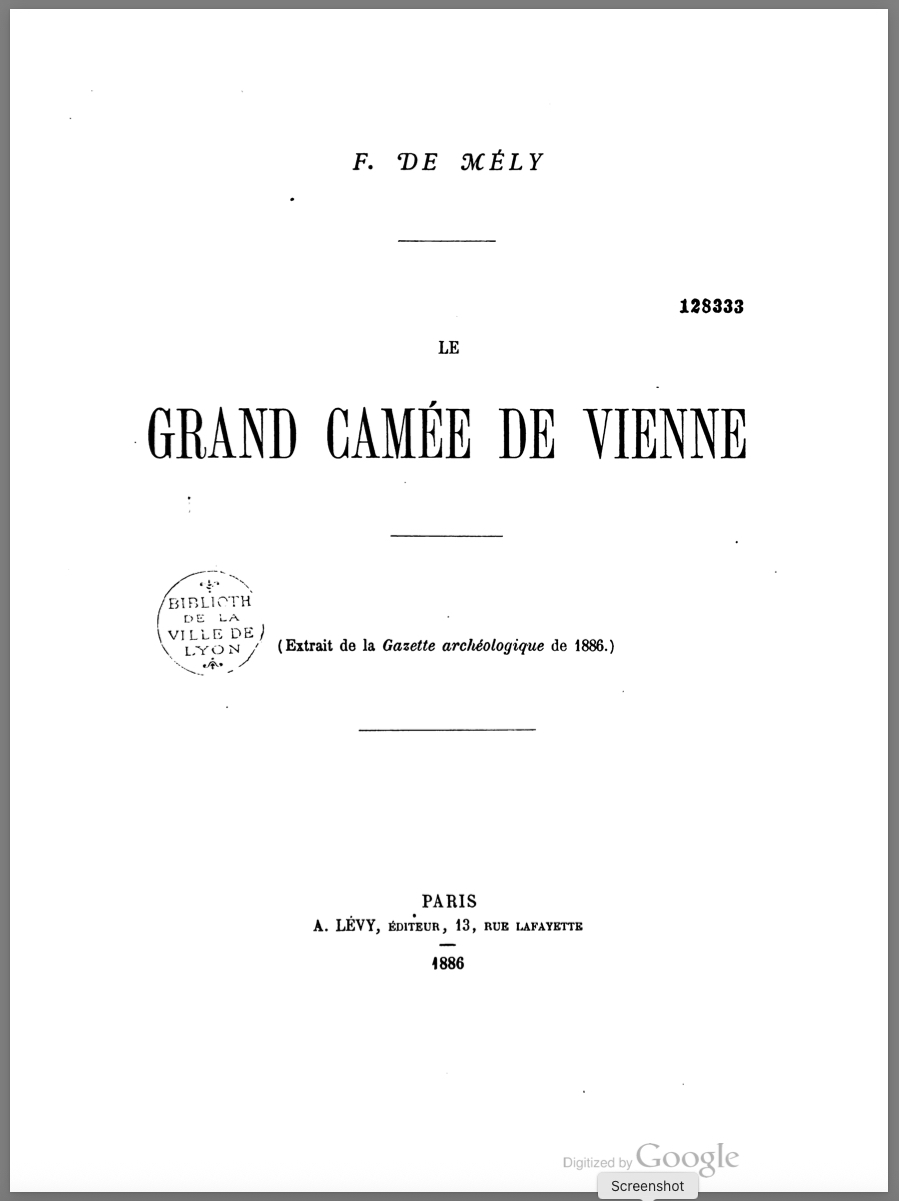
Le grand camée de Vienne et la Camayeul de Saint-Sernin de Toulouse
The Great Cameo of Vienna and the Cameo of Saint-Sernin in Toulouse
Journal Article
Mély, F.d.S., de (1886) Le grand camée de Vienne et la Camayeul de Saint-Sernin de Toulouse. [The Great Cameo of Vienna and the Cameo of Saint-Sernin in Toulouse] Société archéologique du Midi de la France, pp. 3–12.
Sinkankas/Born No.: 4368 (not seen) | Language: in French | RWHL
gems, glyptic, engraved gems, agate, cameo, intaglio
Among the works of art left to us by antiquity, there are few whose history is more obscure, more shrouded in legend than that of cameos. The Middle Ages often replaced the history of figured monuments it did not understand with fables, attributing Christian meaning to entirely pagan subjects. Such was the legend of the bas-relief of Les Baux, where the piety of the faithful saw the holy Marys, venerated in the Camargue and the region of Arles; such also was the fate of the cameo of Chartres, which depicts Jupiter and in which all the inventories of Chartres Cathedral saw, almost up to the 17th century, a Saint John the Evangelist. The finest engraved stones generally belonged to the treasuries of cathedral or monastic churches, which had received them as gifts and, seeing in their subjects only depictions of religious scenes, transformed the gods of Olympus and the Roman emperors into patriarchs and evangelists—thus further deepening the obscurity surrounding their origins through these misinterpretations. This is how the cameo of the Sainte-Chapelle came to be called the Triumph of Joseph, before Peiresc restored its true name, the Agate of Tiberius, in 1619. At the same time, the learned archaeologist obtained from Vienna a sulfur cast of the Great Cameo, to which he gave the name Triumph of Augustus, later changed by Köhler to Glory of Augustus.³ Peiresc described this magnificent stone and explained how it had entered the treasury of the emperors of Germany. Brought back from Palestine by the Knights of Saint John of Jerusalem, given by them to Philip the Fair, and bequeathed by the king to the convent of Poissy, which he had founded in 1304, this cameo was allegedly taken during the Wars of Religion in the 16th century (1562) and sold for twelve thousand gold écus to Rudolf II.