
Four Treasures Reference Database
Record No. 27891
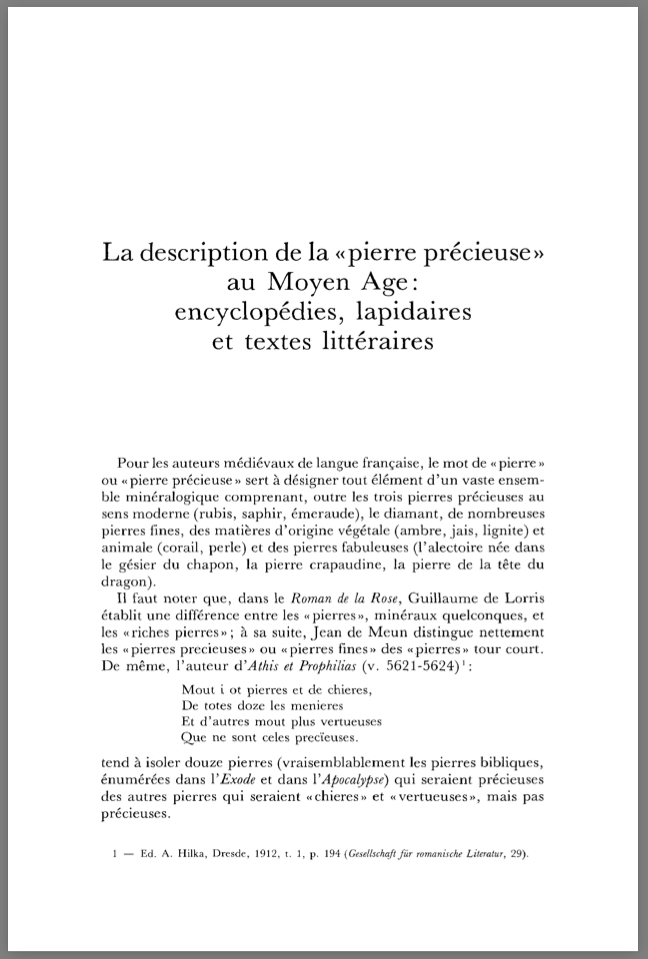
La description de la “pierre précieuse” au Moyen Âge: Encyclopédies, lapidaires et textes littéraires
The description of the precious stone in the Middle Ages: encyclopedias, lapidaries, and literary texts
Journal Article
Fery-Hue, F. (1993) La description de la “pierre précieuse” au Moyen Âge: Encyclopédies, lapidaires et textes littéraires. [The description of the precious stone in the Middle Ages: encyclopedias, lapidaries, and literary texts] Bien dire et bien aprendre, No. 11, pp. 147–176.
DOI: https://dx.doi.org/10.54563/bdba.1347 | Sinkankas/Born No.: NIS/NIB | Language: in French | RWHL*
Close Abstract
Hide Keywords
Copy Reference
gems, ancient lapidaries, Albertus Magnus, alchemy, early gemology, early mineralogy
For medieval French-speaking authors, the term “stone” or “precious stone” is used to designate any element within a vast mineralogical ensemble that includes, in addition to the three precious stones in the modern sense (ruby, sapphire, emerald), the diamond, numerous semi-precious stones, materials of plant origin (amber, jet, lignite) and animal origin (coral, pearl), as well as fabulous stones (the alectoria born in the gizzard of a capon, the toadstone, the stone from the dragon’s head). It is worth noting that, in the Roman de la Rose, Guillaume de Lorris establishes a distinction between “stones,” meaning ordinary minerals, and “rich stones”; following him, Jean de Meun clearly distinguishes “precious stones” or “fine stones” from plain “stones.” Likewise, the author of Yliadus et Prophilias (vv. 5621–5624): “He had many stones and costly ones, of all twelve kinds, and others far more virtuous than those that are precious,” tends to set apart twelve stones (likely the biblical stones listed in Exodus and Revelation) as being truly precious, distinct from other stones that are “costly” and “virtuous,” but not precious. The lapidaries of the Middle Ages, whether in Latin or French (some were later translated into Italian, English, German…), in verse or in prose, are all more or less heirs to the tradition of Marbode’s De Gemmis, and are mineralogical works par excellence. The description of the “precious stone” typically consists of notes on color—sometimes very precise—indications of hardness, physical properties (electromagnetic phenomena), more rarely its weight, and finally its supposed geographical origins. This is followed by a listing of its “virtues” as an amulet or in the form of collyria, potions, ointments: this body of superstitions and magical remedies perpetuates the medical doctrine of “signatures.” Philippe de Thaon, in his alphabetical Lapidary (vv. 1693–1698), recalls four principal ways in which stones were used: “Moreover, medicine of the elders shows four ways: to touch, to carry, to drink, to gaze upon. These four ways, God placed them with great meaning.”