
Four Treasures Reference Database
Record No. 27908
Deep “plugs” caught in continent-to-continent collisions, gemstones, deposits of metals, oil & gas
Conference Paper
Saul, J.M. (2016) Deep “plugs” caught in continent-to-continent collisions, gemstones, deposits of metals, oil & gas. 35th International Geologic Congress Conference, 27 August–4 September, Capetown
Sinkankas/Born No.: NIS/NIB | RWHL*
gems, geology, East Africa, Kenya, Tanzania, Mozambique belt, impact scars, Ural Mountains, corundum, sapphire, ruby, tanzanite, kornerupine, garnet, tourmaline
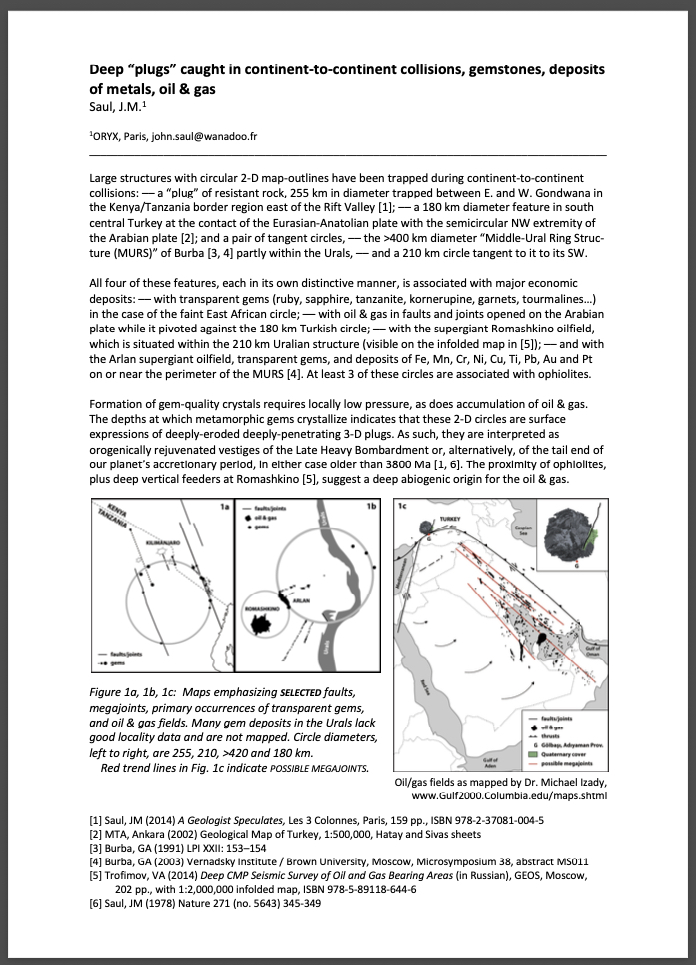
Large structures with circular 2-D map outlines have been trapped during continent-continent collisions: a 255 km wide “plug” of resistant rock at the Kenya–Tanzania border between East and West Gondwana; a 180 km diameter feature in south-central Turkey at the contact of the Eurasian–Anatolian and Arabian plates; and a pair of tangent circles in the Urals—one being the >400 km “Middle-Ural Ring Structure (MURS)” and the other a 210 km circle to its southwest. All four structures are linked with major economic deposits: transparent gems (ruby, sapphire, tanzanite, kornerupine, garnet, tourmaline) in East Africa; oil and gas along faults in the Arabian plate adjacent to the Turkish circle; the Romashkino supergiant oilfield inside the 210 km Uralian circle; and the Arlan oilfield, gems, and multiple metal deposits (Fe, Mn, Cr, Ni, Cu, Ti, Pb, Au, Pt) around the MURS. At least three of these circles are associated with ophiolites. Formation of gem-quality crystals and hydrocarbon accumulation both require low pressure, consistent with these circles representing surface traces of deep, eroded, 3-D plugs. They are interpreted as orogenically rejuvenated vestiges of the Late Heavy Bombardment or the end of Earth’s accretionary period, dating to before 3800 Ma. The presence of ophiolites and vertical feeders (e.g. at Romashkino) supports a deep abiogenic origin for the hydrocarbons.