
Four Treasures Reference Database
Record No. 27915
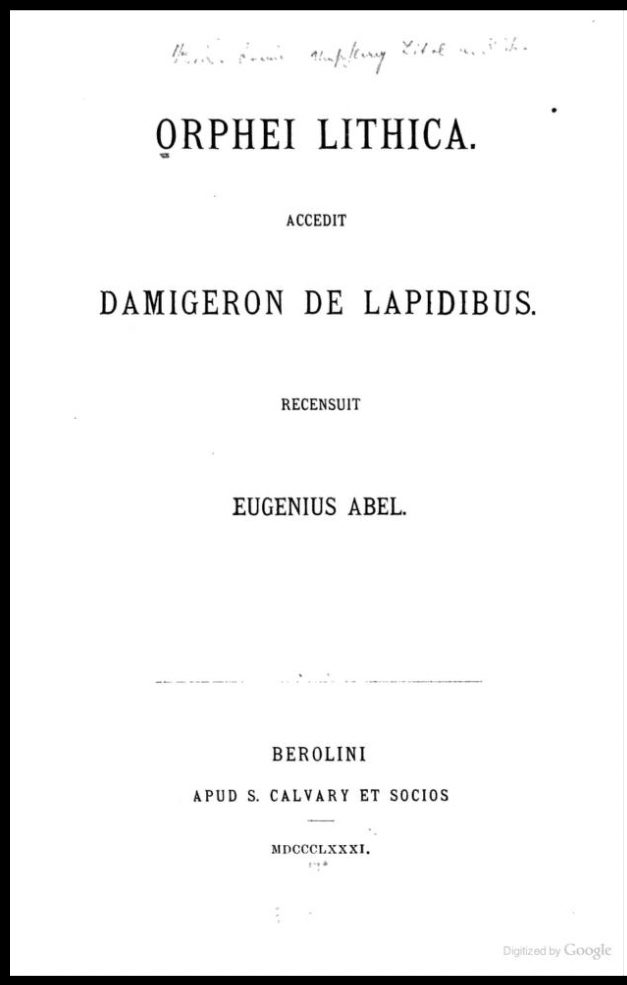
Orphei Lithica accedit Damigeron De Lapidus
Orpheus’ Lithica with Damigeron on Stones.
Book
Orpheus, Damigeron and Abel, E. (1881) Orphei Lithica accedit Damigeron De Lapidus. [Orpheus’ Lithica with Damigeron on Stones.] Berolini, S. Calvary, 198 pp.
Sinkankas/Born No.: NIS/NIB | Language: in Greek and Latin | RWHL
gems, early lapidaries, early gemology, early mineralogy
A Greek poem about stones, which is now at last published in a recension based on the best manuscripts, has long raised great doubts as to which author and period it should be attributed. That Orpheus was the author of our poem—no one now believes this after the excellent studies of Thomas Tyrwhitt. Indeed, Gesner claimed that both Proclus and Stobaeus had attributed the Lithica to Orpheus and often cited it in their works; but Tyrwhitt, referring to the Fabrician index of authors cited by Proclus, showed that Proclus never once mentions the Lithica, a point confirmed by Lobeck after repeated readings of Proclus’s commentaries (Aglaophamus vol. I, p. 377). As for Stobaeus, Tyrwhitt also rightly observed that the passages from the Lithica cited in his name were in fact added much later by Conrad Gesner, and today this is no longer in doubt. Since we do not know when the Greek compiler of the prose epitome of the Lithica lived, and since the author of the Compendium of Rhetoric (last edited by Walz in the sixth volume of Rhetores Graeci) did not flourish before the 15th century, we can name no one before John Tzetzes who attributed the Lithica to Orpheus. Yet Tyrwhitt rightly argued that a writer who assigned astrological, magical, epodic, and hymnic works all to one and the same poet—and who also frequently cited under Orpheus’s name the poem “On the Sacred Laws” by Maximus—was completely lacking in critical judgment. Once we recognize Tzetzes’s ignorance, Tyrwhitt’s suspicion seems unnecessary: that Tzetzes may have come across a book containing all these poems (Lithica, Dodecaeterides, Georgica) together, and, seeing the Epitymnidia—which, being inscribed to Musaeus, seemed attributable by convention to Orpheus—occupying first place, rashly and carelessly assumed that all the poems in the volume were by Orpheus. Slightly more plausible is Lobeck’s view (expressed in Aglaophamus II) that Tzetzes had heard of the Orphic poem On the Use of Stones, which is also mentioned by Suidas, and for that reason attributed the Lithica, included in the same volume as the Argonautica, to Orpheus. But however the matter stands, it is certain that there is nothing in the whole poem that tastes of the muse of that ancient Orpheus. Therefore, setting aside the fancies of Tzetzes and his pre-Tyrwhitt editors, let us proceed to determine more accurately the date of the anonymous author. In this effort, we will follow Tyrwhitt and begin with verses 67–74 of the Lithica, in which it is beyond doubt that the persecution of magical arts and their practitioners is being described. In the year 357, the first law of Constantius appeared: “He shall be punished with death who refuses obedience to our commands”—that is, “Chaldeans and Magi and others whom the common people call sorcerers because of the magnitude of their crimes.” A few years later (in 371), under Valens, the Christian rage against magicians flared even more violently. According to Ammianus Marcellinus (XXIX), their homes were marked, and often…