
Four Treasures Reference Database
Record No. 27916
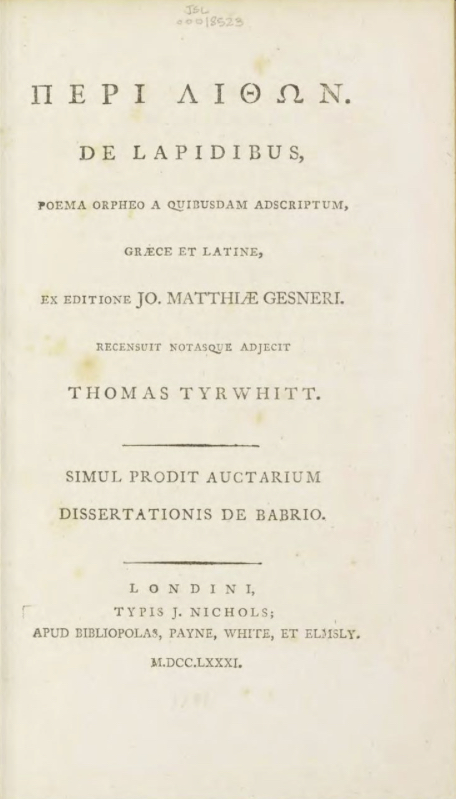
ΠΕΡΙ ΛΙΘΩΝ. De Lapidus, Poema Orpheo a a quibusdam adscriptum, Græce et latine, ex editione Jo. Matthiæ Gesneri. Recensuit notasque adjecit Thomas Tyrwhitt. Simul prodit Auctarium dissertationes de Babrio
On Stones. De Lapidibus, a poem attributed to Orpheus by some, in Greek and Latin, from the edition of Johann Matthias Gesner. Edited and with notes added by Thomas Tyrwhitt. Published together with a supplement to the dissertation on Babrius.
Edited Book
Orpheus and Tyrwhitt, T., editor (1781) ΠΕΡΙ ΛΙΘΩΝ. De Lapidus, Poema Orpheo a a quibusdam adscriptum, Græce et latine, ex editione Jo. Matthiæ Gesneri. Recensuit notasque adjecit Thomas Tyrwhitt. Simul prodit Auctarium dissertationes de Babrio. [On Stones. De Lapidibus, a poem attributed to Orpheus by some, in Greek and Latin, from the edition of Johann Matthias Gesner. Edited and with notes added by Thomas Tyrwhitt. Published together with a supplement to the dissertation on Babrius.]. London, J. Nichols, 55 pp..
Sinkankas/Born No.: 4893 | Language: in Latin and Greek | RWHL
gems, early lapidaries, early gemology, early mineralogy, Orpheus, Peri Lithon, De Lapidibus
Sinkankas: Text in Greek and Latin. Recto: Περί Λίθων or De lapidibus appears on f.65–30 verso. According to Thorndike (ibid., p. 294), “the Lithica, representing Hermes, opens by bestowing upon mankind the precious lore of the marvelous virtues of gems… After this introduction… the virtues of the individual stones are described, first in the words of Theodamas, a wise and divine man whom the author meets on his way to perform annual sacrifice at an altar of the Sun… The virtues of a number of gems are attributed to Apollo rather than Hermes; and there are allusions to Greek mythology and the Trojan War. Some gems are found in animals, for instance, in the viper or the brain of the stag.” Thorndike then examines some of the stones and the magical powers attributed to them (pp. 294–297). He also notes Abel’s reproduction of the Greek text (see below), and the translation by C. W. King in The Natural History, Ancient and Modern, of Precious Stones and of Precious Metals, 1865, which he considers to be “a rather too free English verse translation.” See also Adams, The Birth and Development of the Geological Sciences, pp. 28–32; British Museum, Italian Books, p. 457; Brunet 3:1957; Dibdin, Greek and Latin Classics, 2:239; STC, Class. See also the comments of F. D. Thomas Tyrwhitt was of the opinion that the original manuscript was composed before Constantine (306 AD) and not long after 364 AD.