
Four Treasures Reference Database
Record No. 27928
Some historical notes on spectacles and on beryllus
Journal Article
Doesschate, G.T. (1946) Some historical notes on spectacles and on beryllus. British Journal of Ophthalmology, Vol. 30, No. 11, pp. 660–664.
Sinkankas/Born No.: NIS/NIB | RWHL*
Close Abstract
Hide Keywords
Copy Reference
gems, early science, early optics, Arabic mineralogy, Arabic science, eyeglasses, sunglasses, beryl, aquamarine, Ptolemy, early lapidaries
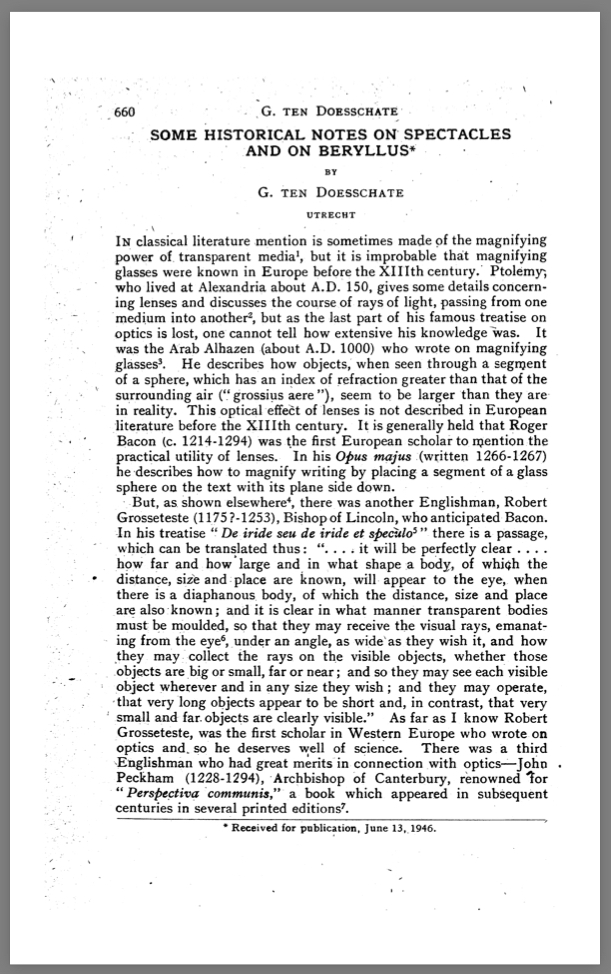
In classical literature, mention is sometimes made of the magnifying power of transparent media, but it is improbable that magnifying glasses were known in Europe before the 13th century. Ptolemy, who lived at Alexandria around A.D. 150, gives some details concerning lenses and discusses the course of rays of light passing from one medium into another, but as the last part of his famous treatise on optics is lost, one cannot tell how extensive his knowledge was. It was the Arab Alhazen (circa A.D. 1000) who wrote on magnifying glasses. He describes how objects, when seen through a segment of a sphere with an index of refraction greater than that of the surrounding air (“grossius aere”), appear larger than they are in reality. This optical effect of lenses is not described in European literature before the 13th century. It is generally held that Roger Bacon (c. 1214–1294) was the first European scholar to mention the practical utility of lenses. In his Opus maius (written 1266–1267), he describes how to magnify writing by placing a segment of a glass sphere on the text with its plane side down. But, as shown elsewhere, there was another Englishman, Robert Grosseteste (1175?–1253), Bishop of Lincoln, who anticipated Bacon. In his treatise De iride seu de iride et speculo there is a passage which can be translated thus: “…it will be perfectly clear… how far and how large and in what shape a body, of which the distance, size, and place are known, will appear to the eye, when there is a diaphanous body, of which the distance, size, and place are also known; and it is clear in what manner transparent bodies must be moulded, so that they may receive the visual rays, emanating from the eye, under an angle as wide as they wish it, and how they may collect the rays on the visible objects, whether those objects are big or small, far or near; and so they may see each visible object wherever and in any size they wish; and they may operate, so that very long objects appear to be short and, in contrast, that very small and far objects are clearly visible.” As far as I know, Robert Grosseteste was the first scholar in Western Europe who wrote on optics, and so he deserves well of science. There was a third Englishman who had great merits in connection with optics—John Peckham (1228–1294), Archbishop of Canterbury, renowned for Perspectiva communis, a book which appeared in subsequent centuries in several printed editions.