
Four Treasures Reference Database
Record No. 27933
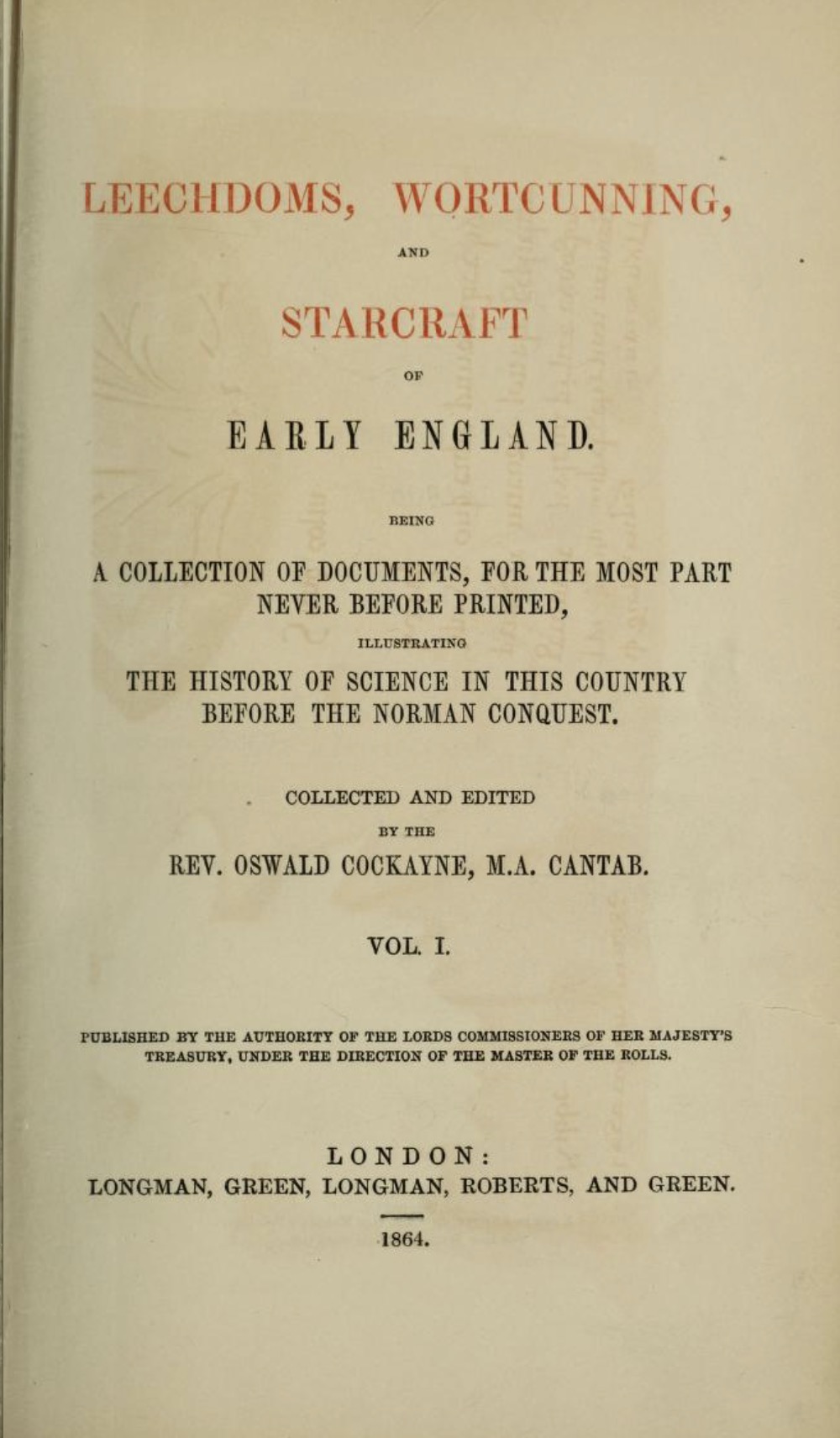
Leechdoms, Wortcunning, and Starcraft of Early England: Being a Collection of Documents, for the Most Part Never before Printed, Illustrating the History of Science in This Country before the Norman Conquest
Edited Book
Cockayne, T.O., editor (1864) Leechdoms, Wortcunning, and Starcraft of Early England: Being a Collection of Documents, for the Most Part Never before Printed, Illustrating the History of Science in This Country before the Norman Conquest.. London, Longman, Green, Roberts, 3 Vols., 405, 415, 454 pp..
Sinkankas/Born No.: NIS/NIB | RWHL
Close Abstract
Hide Keywords
Copy Reference
gems, early lapidaries, early gemology, early mineralogy, herbals, gems and healing, medicinal gems
This three-volume work, published in 1864–6, was edited by Thomas Oswald Cockayne (1807–73), a Cambridge graduate, much-published early member of the London Philological Society, and teacher of the philologists Walter Skeat and Henry Sweet. It is a collection of writings from pre-Conquest Britain on plants, medicine and the heavens, mostly in Old English with accompanying modern English translations. Vol. 1: Volume 1 begins with a substantial preface outlining the Anglo-Saxon reception of Greek and Latin medical texts. The main work in this volume is an Old English version of the late Latin Herbarium formerly attributed to Apuleius, augmented by material deriving from Dioscorides' De Materia Medica. The volume concludes with an Old English translation of the fourth-century Roman physician Sextus Placitus' writings on animal-derived medicines, and some short medicinal recipes in Old English and Latin taken from the fly leaves of manuscripts. Vol. 2: The preface of Volume 2 outlines evidence for early medieval British material culture, particularly foodstuffs, drink, fabrics and metals, and argues against dismissing the Anglo-Saxons and their contemporaries as 'primitive'. The Old English text in this volume is taken from a tenth-century manuscript in the Royal Collection, which Cockayne suggests may have belonged to the Abbot of Glastonbury. It is a careful and thorough compilation of remedies for conditions ranging from toothache to complications of pregnancy, and digestive problems to mental illness, and reveals the influence of Greek medical learning in the Anglo-Saxon world. Vol. 3: The preface of Volume 3 discusses questions including the identity of the Anglo-Saxon translator of Bede's De Temporibus and the similarities between Classical and medieval dream-interpretation and divination, and the Victorian penchant for spiritualism and astrology. The texts in this volume include remedies, charms and prayers for the sick, in Latin and Old English, lists of plant names, works on solar and lunar calendars and horoscopes, and explanations of the prophetic meaning of dreams. The volume ends with some historical fragments in Old English relating to monastic foundations.